
Flat Maintenance Charges in Bangalore: Legal Dispute Over Flat Size-Based Billing
In large apartment complexes across Bangalore, disputes over Apartment Maintenance Charges in Bangalore have become increasingly common. In many cases, apartment associations charge owners of larger flats significantly higher maintenance fees than owners of smaller flats. However, both categories of residents usually use the same lifts, clubhouse, security services, corridors, housekeeping, gardens, and power backup facilities.
Therefore, an important legal question arises: can apartment associations legally calculate flat maintenance charges based on flat size when all residents enjoy common amenities equally?
A major judgment delivered by the XL Additional City Civil and Sessions Judge, Bengaluru, in Arun Kumar Rao v. Purva Seasons Owners Association on 20 November 2025 addressed this issue directly. The court held that the maintenance model adopted in that case was not legally sustainable and directed the association to levy common maintenance equally on a per-flat basis.
Table of Contents
Background of the Flat Maintenance Charges Dispute
The dispute arose in O.S. No. 5482/2020. The plaintiff, who owned a flat in Purva Seasons, challenged a virtual extraordinary general body meeting resolution dated 25 July 2020. Additionally, he challenged maintenance invoices raised between May and December 2020.
The apartment complex consisted of 660 flats spread across multiple towers. The association introduced a hybrid maintenance model that linked a significant portion of the flat maintenance charges to the super built-up area of each apartment.
However, the plaintiff argued that all owners used the same common amenities and infrastructure. Therefore, the association could not legally demand higher charges merely because some apartments had larger super built-up areas.
Why the Plaintiff Challenged Area-Based Flat Maintenance Charges?
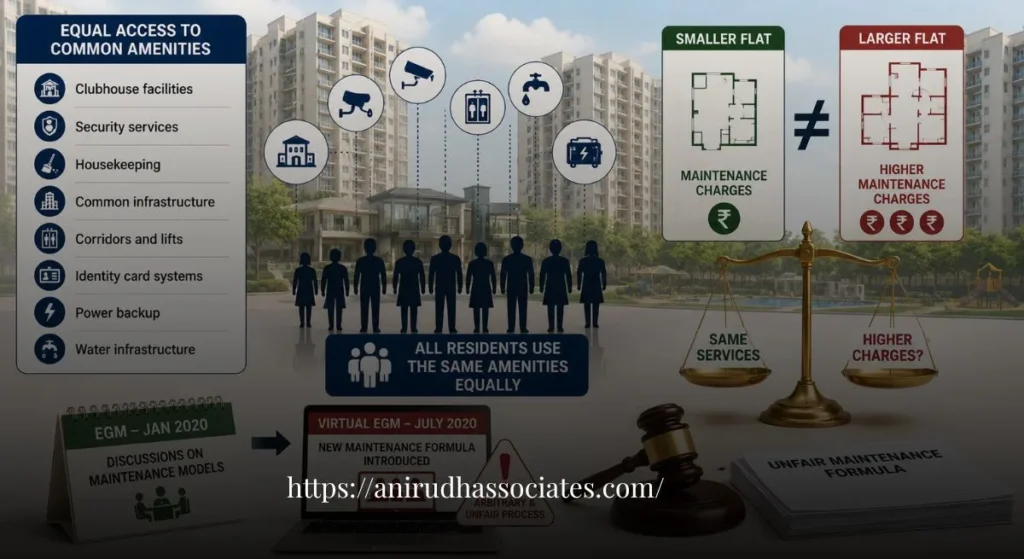
The plaintiff based his arguments on the actual usage of common amenities within the apartment complex. According to the evidence presented before the court, all residents had equal access to:
- Clubhouse facilities
- Security services
- Housekeeping
- Common infrastructure
- Corridors and lifts
- Identity card systems
- Power backup
- Water infrastructure
Moreover, the plaintiff argued that larger flat owners did not receive additional or superior services compared to smaller flat owners. Consequently, charging higher flat maintenance charges solely because of apartment size lacked a rational basis.
The plaintiff also referred to earlier discussions held during a January 2020 extraordinary general body meeting. He claimed that the later virtual voting process improperly introduced an arbitrary maintenance formula.
Association’s Defence on Flat Maintenance Charges
On the other hand, the apartment association defended its maintenance model by relying on the Karnataka Apartment Ownership Act, 1972 and the existing bye-laws.
The association argued that:
- The deed of declaration permitted pro rata assessment based on the super built-up area.
- The general body approved the maintenance model democratically.
- The plaintiff represented only a minority dissenting opinion.
- The revised formula followed internal procedures and amendments.
Therefore, the association claimed that the majority decision should prevail over individual objections.
Court’s View on Common Amenities and Maintenance Charges
The Bengaluru court carefully examined the sale deeds, association records, invoices, emails, legal notices, and other documentary evidence. After reviewing the material, the court accepted the plaintiff’s core argument.
The court observed that all residents enjoyed the same common facilities regardless of apartment size. Furthermore, it held that larger flats did not automatically consume more common services simply because their area was bigger.
As a result, the court concluded that there was no reasonable justification for imposing higher flat maintenance charges for common amenities on owners of larger apartments.
The judgment also relied on principles discussed in Venus Co-operative Housing Society v. J.Y. Detwani, where courts had similarly held that apartment associations cannot pass arbitrary or irrational resolutions
Practical Reasoning Applied by the Court
Importantly, the court also considered the practical realities of apartment living. It noted that:
- A smaller flat may house more residents.
- A larger flat may house fewer occupants.
- Yet both flats use the same lifts, generators, security, corridors, and clubhouse facilities.
Therefore, the actual usage of common infrastructure often remains substantially similar across flats of different sizes.
This reasoning significantly weakened the association’s defence of area-based flat maintenance charges.
Issues in the Virtual General Body Meeting
Another major issue involved the conduct of the virtual extraordinary general body meeting held on 25 July 2020.
The plaintiff alleged several procedural irregularities, including:
- Confusion in voting procedures
- Technical issues in the apartment management software
- Inconsistent email instructions
- Difficulties faced by multiple-flat owners
- Lack of transparency in the voting process
The court considered these objections seriously. Consequently, these procedural concerns further weakened the validity of the maintenance model adopted by the association.
Final Judgment on Flat Maintenance Charges
Ultimately, the court ruled in favour of the plaintiff. It declared that:
- The resolution passed under Agenda No. 5 during the virtual meeting was null and void.
- The maintenance invoices raised between May and December 2020 were not binding on the plaintiff.
- The association could not levy flat maintenance charges for common amenities based solely on apartment area.
Most importantly, the court directed the association to calculate maintenance charges equally on a per-flat basis for commonly enjoyed services and facilities.
Additionally, the court restrained the association from taking coercive actions such as disconnecting electricity, water supply, or other essential services against the plaintiff.
Why This Judgment Matters for Apartment Owners?
This ruling is highly significant for apartment owners across Bangalore. It clarifies that apartment associations cannot blindly rely on majority resolutions if the maintenance structure itself appears irrational or unfair.
Moreover, the judgment highlights that courts will closely examine:
- The actual nature of common amenities
- The fairness of the maintenance formula
- The transparency of voting procedures
- The rational basis for charging different owners differently
However, the judgment does not automatically invalidate every area-based maintenance model. Instead, courts will evaluate whether the formula reasonably matches the nature of the expenses involved.
Key Takeaways for Apartment Associations
Apartment associations must ensure that their maintenance policies remain legally defensible. Therefore, they should:
- Maintain transparent voting procedures
- Avoid arbitrary maintenance formulas
- Draft legally sound bye-laws
- Ensure fairness in cost allocation
Similarly, apartment owners should understand that unfair flat maintenance charges can be challenged before civil courts if the association’s actions become unreasonable or coercive.
“Associations should seek guidance from a Corporate Lawyer in Bangalore before implementing major changes to maintenance structures or bye-laws.”
Conclusion: Legal Position on Flat Maintenance Charges in Bangalore
As Bangalore’s apartment communities continue to grow, disputes relating to flat maintenance charges will likely increase. This judgment reinforces an important legal principle: where residents equally enjoy common infrastructure and amenities, associations must adopt a fair and rational method for sharing maintenance expenses.
Therefore, apartment associations cannot impose unequal financial burdens without proper legal justification. Fairness, transparency, and reasonableness remain central to apartment governance under the law