An Arbitration Clause in Oppression and Mismanagement disputes often becomes a contentious issue when shareholders disagree over the management of a company. Many shareholder agreements, joint venture agreements, and share subscription agreements contain arbitration clauses requiring parties to resolve disputes through private arbitration. However, not every corporate dispute can be decided by an arbitral tribunal.
When shareholders invoke Sections 241 and 242 of the Companies Act, 2013, they seek statutory remedies designed to protect the company, minority shareholders, and corporate governance. Consequently, Indian courts have consistently held that an arbitration clause cannot override the statutory jurisdiction of the National Company Law Tribunal (NCLT) in genuine oppression and mismanagement cases.
This article explains why an arbitration clause in Oppression and Mismanagement disputes does not automatically prevent proceedings before the NCLT, the leading judicial precedents, and the practical implications for founders, investors, and shareholders.
Table of Contents
What Is an Arbitration Clause in Oppression and Mismanagement Cases?
An arbitration clause requires parties to resolve contractual disputes through arbitration instead of litigation. It commonly appears in:
- Shareholders’ Agreements (SHA)
- Share Subscription Agreements (SSA)
- Joint Venture Agreements (JVA)
- Investment Agreements
However, oppression and mismanagement petitions are fundamentally different.
Unlike contractual disputes, petitions under Sections 241 and 242 invoke statutory rights granted by the Companies Act. Therefore, the dispute extends beyond the contractual relationship between shareholders and concerns the company’s governance itself.
As a result, an arbitration clause cannot automatically exclude the NCLT’s jurisdiction.
Why Doesn't an Arbitration Clause Override the NCLT's Jurisdiction?
The NCLT exercises statutory powers that an arbitral tribunal cannot.
Under Sections 241 and 242, the Tribunal may:
Regulate the Company’s Affairs
The NCLT may issue directions regarding how the company should operate to end oppressive conduct.
Remove or Appoint Directors
The Tribunal may remove directors or modify the company’s management structure whenever necessary.
Restrict Share Transfers or Allotments
The Tribunal may cancel or restrict transactions that prejudice shareholders.
Set Aside Oppressive Transactions
The NCLT can invalidate transactions that harm the company or minority shareholders.
Since these remedies arise directly from statute rather than contract, an arbitral tribunal lacks the authority to grant them.
Since oppression and mismanagement petitions must be filed before the NCLT when statutory remedies are sought, understanding How to File Case in NCLT Bangalore can help shareholders and companies follow the correct legal procedure.
What Has the Supreme Court Said About Arbitrability?
The Supreme Court has consistently distinguished statutory corporate remedies from private contractual disputes.
Haryana Telecom Ltd. v. Sterlite Industries
The Court held that arbitration applies only when an arbitrator has the legal authority to grant the requested relief. Since only a statutory forum could order the winding up of a company, the dispute remained non-arbitrable.
Booz Allen and Hamilton Inc. v. SBI Home Finance Ltd.
The Supreme Court explained that disputes involving rights in rem generally cannot be resolved through arbitration because they affect persons beyond the contracting parties.
These decisions laid the foundation for later judgments involving oppression and mismanagement.
How Have Courts Applied These Principles to Oppression and Mismanagement Cases?
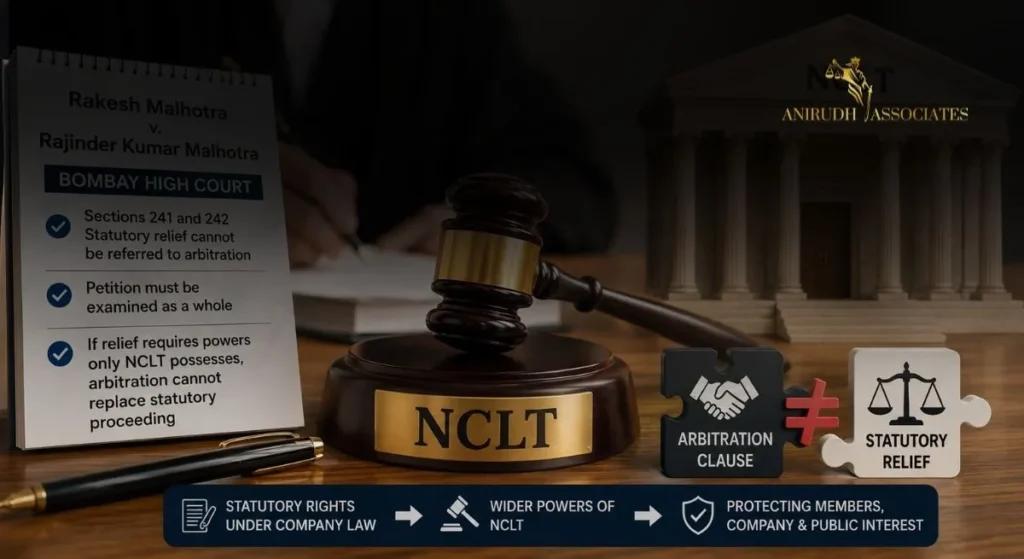
The Bombay High Court directly addressed this issue in Rakesh Malhotra v. Rajinder Kumar Malhotra.
The Court held that where a petition genuinely seeks statutory relief under Sections 241 and 242, the existence of an arbitration clause does not require the matter to be referred to arbitration.
Furthermore, the Court clarified that judges must examine the petition as a whole instead of separating contractual allegations from statutory claims.
Therefore, if the relief sought requires powers that only the NCLT possesses, arbitration cannot replace the statutory proceeding.
Can Courts Split the Dispute Between Arbitration and NCLT?
Generally, no.
Parties frequently argue that only part of the dispute concerns oppression while the remaining issues relate to contractual obligations.
However, courts have rejected artificial bifurcation where the statutory relief forms the core of the dispute.
Instead, the Court examines:
- The allegations
- The relief sought
- The substance of the petition
- The statutory powers required
If the petition genuinely invokes Sections 241 and 242, the NCLT retains jurisdiction.
When Can an Arbitration Clause Still Apply?
An arbitration clause continues to govern purely contractual disputes.
For example, arbitration may decide disputes involving:
Share Purchase Obligations
Disagreements over payment obligations under shareholder agreements.
Exit Rights
Disputes involving contractual exit mechanisms.
Valuation Issues
Questions regarding share valuation under private agreements.
Commercial Obligations
Claims involving warranties, indemnities, or contractual breaches.
However, once allegations concern oppressive conduct affecting the company’s affairs, statutory remedies become available, and the dispute moves into the NCLT’s jurisdiction.
What Did the NCLAT Decide?
The NCLAT reaffirmed this principle in Dhananjay Mishra v. Dynatron Services Pvt. Ltd.
The appellate tribunal observed that:
- Oppression and mismanagement petitions derive from statutory rights.
- The NCLT possesses powers unavailable to arbitral tribunals.
- Corporate governance issues require statutory intervention.
- Arbitration agreements cannot eliminate remedies created by the Companies Act.
Accordingly, the existence of arbitration proceedings does not bar an oppression and mismanagement petition.
When Might Courts Reject an Oppression and Mismanagement Petition?
Although arbitration clauses cannot override genuine statutory claims, courts carefully examine whether the petition is bona fide.
For instance, the company law forum may refuse relief if:
- The petition is merely a contractual dispute.
- The pleadings attempt to avoid arbitration through clever drafting.
- The allegations lack any genuine oppression or mismanagement.
- The petitioner seeks only contractual remedies disguised as statutory claims.
Therefore, courts focus on the substance of the dispute rather than its label.
What Does This Mean for Founders, Investors, and Shareholders?
Businesses should not assume that an arbitration clause protects them from every shareholder dispute.
Instead:
- Arbitration continues to govern contractual claims.
- The NCLT decides genuine oppression and mismanagement petitions.
- Statutory remedies remain available despite private agreements.
- Companies should carefully draft shareholder agreements while understanding their legal limitations.
Consequently, founders and investors should evaluate both contractual rights and statutory remedies before initiating legal proceedings.
Conclusion
An Arbitration Clause in Oppression and Mismanagement disputes does not automatically prevent proceedings before the NCLT. Indian courts have consistently recognised that petitions under Sections 241 and 242 involve statutory rights and remedies that extend beyond ordinary contractual obligations.
Accordingly, while arbitration remains an effective mechanism for resolving private commercial disputes, it cannot replace statutory corporate remedies requiring the exercise of powers exclusively vested in the NCLT. Businesses, investors, and shareholders should therefore assess the true nature of the dispute before deciding the appropriate forum. Consulting an NCLT lawyer in Bangalore can help determine whether the matter should proceed before the NCLT or through arbitration.