
Securing ₹94 Crore for Minority Shareholders Form Bharti Telecom - Case INtrodution
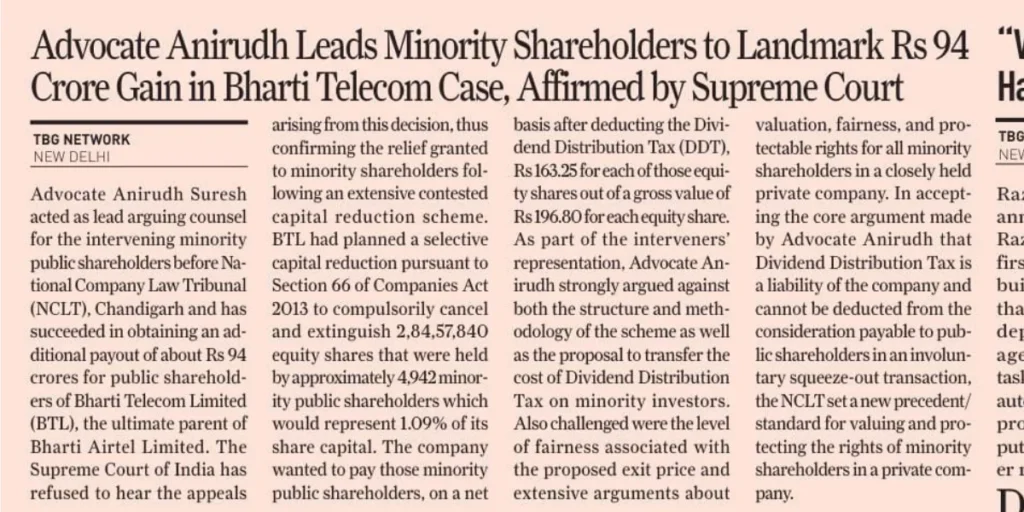
Corporate restructuring often raises critical questions around fairness, valuation, and the protection of minority shareholders. In the Bharti Telecom capital reduction case, Advocate Anirudh, representing intervening minority shareholders, played a key role in securing a materially improved financial outcome.
This case highlights the importance of experienced representation in corporate disputes and reinforces the role of judicial scrutiny in ensuring equitable treatment of all stakeholders.
Understanding the Bharti Telecom Capital Reduction Case
Bharti Telecom Limited proposed a selective capital reduction under Section 66 of the Companies Act, 2013. The scheme involved the compulsory cancellation of shares held by minority public shareholders.
Key aspects of the proposal included:
- Exit price structured at ₹163.25 per share after deduction of Dividend Distribution Tax (DDT)
- Impact on approximately 4,942 minority shareholders
- Total shareholding affected: 1.09% of the company’s capital
The central issue was whether the company could pass on the tax burden to minority shareholders while determining the exit consideration.
Legal Challenge in the Bharti Telecom Case: Protecting Minority Shareholder Interests
Appearing before the National Company Law Tribunal, Advocate Anirudh, our Chief Corporate Lawyer from Bangalore, challenged both the structure and fairness of the proposed scheme.
The arguments focused on:
- The legality of deducting DDT from shareholder payouts
- Fair valuation principles in compulsory exits
- The broader need to protect minority shareholders in closely held corporate structures
A key position advanced was that Dividend Distribution Tax is a liability of the company and cannot be imposed on shareholders through reduced consideration.
Outcome of the Bharti Telecom Capital Reduction Case: ₹94 Crore Additional Value Secured
The Tribunal accepted the core arguments and directed that shareholders be paid the full valuation of ₹196.80 per share, without deducting DDT.
This resulted in:
- An increase of ₹33.55 per share
- Approximately ₹94 crore in additional payout to minority shareholders
Subsequently, the Supreme Court of India dismissed the appeals, affirming the Tribunal’s decision and bringing finality to the matter.
Why the Bharti Telecom Case Matters in Corporate Law?
- Reinforces Minority Shareholder Protection – The decision strengthens the principle that minority shareholders must receive fair and equitable treatment in corporate restructuring.
- Establishes Clarity on Tax Treatment – The ruling clarifies that companies cannot transfer tax liabilities to shareholders in capital reduction schemes.
- Sets a Precedent for Valuation Fairness – Courts and tribunals are likely to closely examine valuation methodologies in future corporate transactions.
Strategic Insight: Role of Corporate Lawyers in Bangalore
This case demonstrates how corporate litigation requires a combination of:
- Deep understanding of company law provisions
- Strong courtroom advocacy
- Ability to align legal arguments with commercial realities
For businesses and shareholders navigating complex restructuring or disputes, engaging experienced professionals is critical to safeguarding interests.
Our Approach to Corporate Litigations in Bangalore
At Anirudh Associates, our approach focuses on:
- Analysing the structure and intent of corporate transactions
- Identifying risks to minority shareholders and stakeholders
- Challenging unfair valuation and governance practices
- Representing clients across tribunals and appellate forums
This matter reflects our commitment to ensuring that legal processes remain fair, transparent, and aligned with statutory principles.
Conclusion: Impact of the Bharti Telecom Capital Reduction Case on Corporate Governance
The outcome of this case marks an important development in Indian corporate law, particularly in the context of capital reduction and minority shareholder rights.
It also highlights the impact that structured legal arguments and effective representation can have in complex corporate disputes.