Why the Supreme Court Intervened
In its December 2025 judgment, the Court had already flagged that the Dowry Prohibition Act, 1961 suffers from various difficulties in its implementation, and that both under-enforcement and misuse of the law create what it described as a “judicial tension” requiring urgent resolution. The August 2026 order translates that concern into ten concrete, time-bound directions addressed to trial courts, High Courts, and State governments.
Earlier Supreme Court judgment:
The December 15, 2025 judgment in State of U.P. v. Ajmal Beg restored the trial court’s convictions and separately set out directions concerning implementation and enforcement of dowry-related laws. Read the December 2025 judgment.
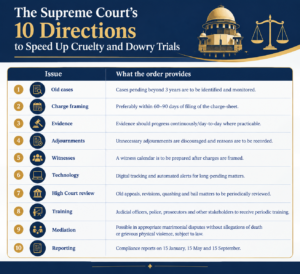
The Supreme Court’s 10 Directions: At a Glance
Issue | What the order provides |
Old cases | Cases pending beyond 3 years are to be identified and monitored |
Charge framing | Preferably within 60–90 days of filing of the charge-sheet |
Evidence | Evidence should progress continuously/day-to-day where practicable |
Adjournments | Unnecessary adjournments are discouraged and reasons are to be recorded |
Witnesses | A witness calendar is to be prepared after charges are framed |
Technology | Digital tracking and automated alerts for long-pending matters |
High Court review | Old appeals, revisions, quashing and bail matters to be periodically reviewed |
Training | Judicial officers, police, prosecutors and other stakeholders to receive periodic training |
Mediation | Possible in appropriate matrimonial disputes without allegations of death or grievous physical violence, subject to law |
Reporting | Compliance reports on 15 January, 15 May and 15 September |
The Court’s August 20 order records the continuing compliance framework and directs that the matter be listed with compliance-cum-periodic reports on 15 October 2026.
The Ten Directions, Explained
Institutional support mechanisms
States and Union Territories must ensure Dowry Prohibition Officers are functioning effectively, and strengthen One Stop Centres, Family Counselling Centres, Women Help Desks, victim assistance services, helplines and online grievance redressal systems.
Awareness and educational measures
State Education Departments, Women and Child Development Departments, and State Legal Services Authorities must run sustained awareness programmes on dowry, gender equality and women’s rights, including through school and college curricula.
Priority classification and monitoring
Courts must treat Section 304-B and 498-A cases as priority matters. District Judiciary must identify cases pending beyond three years for monthly or quarterly review.
Time-bound trial progression.
Trial courts must, as far as practicable, secure prompt appearance of the accused after the charge-sheet is filed, frame charges preferably within 60 to 90 days, and record evidence on a continuous, day-to-day basis under Section 309 CrPC / Section 346 BNSS.
The Court clarified these are “directory benchmarks,” not rigid deadlines allowing for cases with multiple accused, forensic delays, or the accused being unavailable.
Regulation of adjournments and witness management.
Courts must discourage unnecessary adjournments, record written reasons when one is granted, appoint Legal Aid Counsel or an Amicus Curiae where defence counsel is repeatedly absent, and prepare a witness calendar right after charges are framed.
Use of technology and digital monitoring
High Courts must integrate stage-wise pendency tracking, digital dashboards and automated alerts for long-pending matters within existing court information systems.
Review of pending matters before High Courts
High Courts must periodically review old pending appeals, revisions, quashing petitions under Section 482 CrPC / Section 528 BNSS, and bail matters particularly those where trial proceedings have been stayed.
Training and specialised prosecution
Periodic training is required for judicial officers, police officials, prosecutors, protection officers and counsellors, with States encouraged to designate prosecutors experienced in offences against women.
Mediation or counselling where appropriate.
In matrimonial disputes without allegations of death or grievous violence, courts may explore mediation or counselling without diluting the seriousness of cognizable offences where such allegations do exist.
Compliance and periodic reporting
High Courts and States/Union Territories must file status reports on 15 January, 15 May and 15 September each year, until pendency in these cases is substantially reduced, covering pendency data, stage-wise status, Dowry Prohibition Officer appointments and training conducted.
The Supreme Court’s order confirms the reporting dates and the categories of information to be covered in the periodic compliance reports.
What the Court Is Trying to Balance
It is worth being precise about what this order does and does not do. The directions are aimed at systemic delay not at diluting the standard of proof, and not at expanding the scope of what counts as an offence. Direction 9, allowing mediation in matrimonial discord cases without allegations of death or grievous violence, exists specifically to make sure the push for speed does not come at the cost of nuance in genuinely different categories of disputes. Read together, the ten directions are about making the existing law function as intended for both the complainant and the accused rather than changing what the law requires.
A Practical Reading of the Order
The practical significance of the order may lie less in the 60–90 day benchmark itself and more in the monitoring architecture around it.
A benchmark becomes meaningful only when a pending case can be identified by stage, reviewed periodically, and accompanied by a recorded reason when proceedings do not move forward. The combination of three-year pendency reviews, witness calendars, written reasons for adjournments, digital tracking and periodic reporting therefore gives the directions an institutional dimension beyond simply asking courts to “speed up” trials.
This is particularly relevant because the Supreme Court’s August 2026 order is not limited to trial courts. It creates responsibilities across the judicial and administrative system, including High Courts, State governments, prosecutors, Dowry Prohibition Officers and other support mechanisms.
Explain, Apply, Act
- What the law says: Trial courts must now work toward framing charges within 60–90 days of the charge-sheet, avoid unnecessary adjournments, and record evidence continuously; High Courts must actively track and review long-pending cases; States must strengthen institutional support and file periodic compliance reports.
- How it applies to real situations: If you are a party to a pending Section 304-B or 498-A case, you or your counsel can now point to these directions when seeking early framing of charges, objecting to repeated adjournments, or seeking priority listing for a case that has been pending for over three years.
- What you should do next: Track whether your case falls within the “pending beyond three years” category that District Judiciary is now required to review, and ensure any request for adjournment or delay is placed on record with reasons, since courts are now expected to scrutinise this more closely.
Timeline to Watch
The matter has been listed for 15 October 2026, when the next round of compliance-cum-periodic reports from States and High Courts will be placed before the Supreme Court, keeping the framework under continuing judicial oversight rather than treating it as a one-time order.
The August 20, 2026 order expressly lists the matter for compliance-cum-periodic reports on 15 October 2026.
What This Means for a Pending 498-A or 304-B Case
The directions do not automatically mean that every pending case will be completed within a fixed period. The 60–90 day charge-framing period is expressed as a directory benchmark, and the Court recognises that cases can involve circumstances such as multiple accused, forensic delays or an accused’s non-availability.
For someone involved in a pending case, the more immediate significance is that delay itself is now subject to a more structured monitoring framework.
That can make the stage of the case particularly important: whether charges have been framed, whether evidence has begun, whether witnesses have been scheduled, whether proceedings have been stayed, and whether the matter has crossed the three-year pendency threshold can all become relevant when considering the Court’s directions.
This does not replace case-specific legal advice. The application of the directions will depend on the procedural stage, facts and orders in the particular proceeding.
Need to Understand How These Directions May Affect Your Pending Case?
If you are dealing with a pending Section 498-A, Section 304-B, or related dowry prosecution, the Supreme Court’s directions may have practical implications for the way your case is monitored and progressed.
Speak with our legal team about your case, its current stage, and the procedural options that may be available to you.