Where the Confusion Comes From?
A company is a separate legal person, distinct from the people who control and own it, and this has been established by Salomon v. Salomon & Co. (1897). However, the concept of “separate legal personality” is not an impenetrable fortress; there are two main doctrines concerning this issue, and they act as opposite forces:
The view of attribution (alter ego doctrine) aims at distinguishing between the acts and mental states of the controllers and the company itself. Meanwhile, peeling off the corporate veil allows seeing through the actions of the company as in the case when a corporation is used as an instrument for achieving some illegal or non-statutory goals.
Can a Company Even Be Prosecuted for Crimes That Require Intent?
There used to be a real argument about this. A company has no mind so can it be prosecuted for something like fraud or cheating, where intent is part of the offence?
The Supreme Court settled it in Standard Chartered Bank v. Directorate of Enforcement, (2005) 4 SCC 530. A company can be prosecuted and punished even for offences that carry a jail term, because the fact that you can’t physically imprison a company doesn’t hand it a free pass.
Then came Iridium India Telecom Ltd. v. Motorola Incorporated, (2011) 1 SCC 74, where the Court went further and confirmed that a company can be criminally liable for offences requiring mens rea as long as the acts and intent of the people actually running the company can be attributed to it.
So if someone at the company’s directing-mind level commits fraud in connection with the company’s business, the company itself can end up facing criminal liability depending on the offence and the facts.
That’s not a blanket rule, though. Not every fraud by every director becomes “the company’s” fraud. It still comes down to the person’s role, what they actually did, and how closely it’s tied to the company’s affairs.
Does the Same Logic Work in Reverse Can a Director Be Prosecuted for What the Company Did?
No and the Supreme Court was clear about this in Sunil Bharti Mittal v. Central Bureau of Investigation, (2015) 4 SCC 609.
The alter ego principle isn’t a two-way street. You can’t flip it around and say a director is automatically liable just because the company committed an offence.
A director can be prosecuted for the company’s offence, but generally only when:
- There’s specific material showing the director personally took part in the offence with the required criminal intent, or
- The relevant statute expressly makes directors (or other responsible officers) liable the kind of provision that targets people “in charge of and responsible for” the company’s conduct.
The bottom line: holding the title “director” is not, by itself, evidence of criminal involvement.
Maksud Saiyed v. State of Gujarat, (2008) 5 SCC 668 reinforces this the Court held that vicarious liability for a managing director or director has to rest on a statutory basis, and the complaint itself needs to spell out the allegations that trigger that liability.
You can’t make someone criminally liable just by writing “director” next to their name.
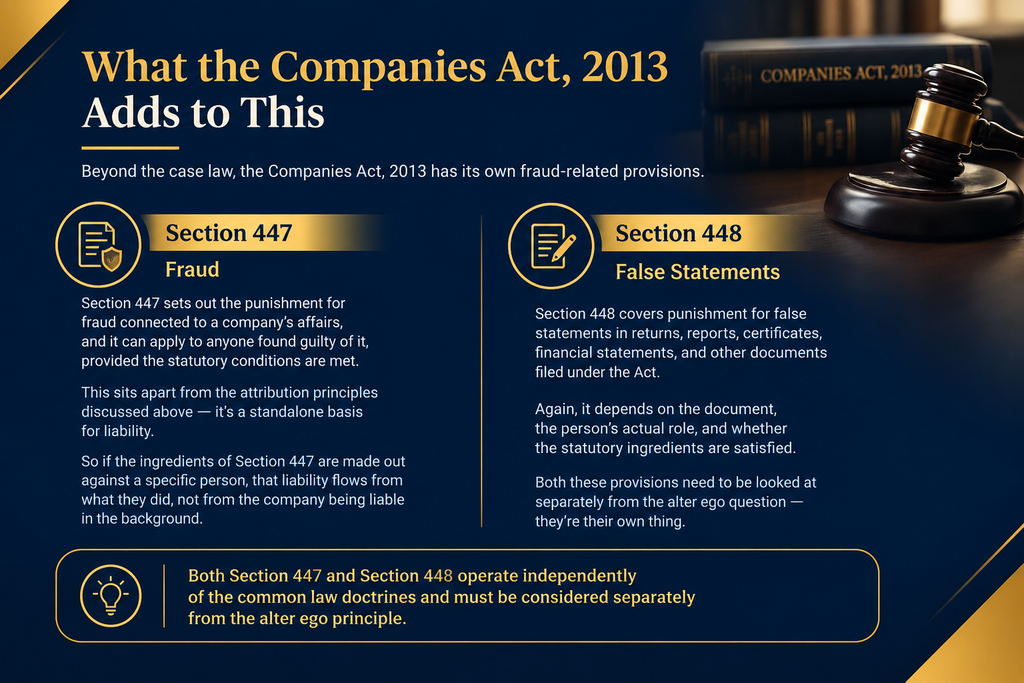
What the Companies Act, 2013 Adds to This
Beyond the case law, the Companies Act, 2013 has its own fraud-related provisions.
Section 447 Fraud
Section 447 sets out the punishment for fraud connected to a company’s affairs, and it can apply to anyone found guilty of it, provided the statutory conditions are met.
This sits apart from the attribution principles discussed above it’s a standalone basis for liability.
So if the ingredients of Section 447 are made out against a specific person, that liability flows from what they did, not from the company being liable in the background.
Section 448 False Statements
Section 448 covers punishment for false statements in returns, reports, certificates, financial statements, and other documents filed under the Act.
Again, it depends on the document, the person’s actual role, and whether the statutory ingredients are satisfied.
Both of these provisions need to be looked at separately from the alter ego question they’re their own thing.
When Do Courts Actually Lift the Corporate Veil?
This is a different doctrine altogether. A company has its own legal identity, but courts will look past it in the right circumstances typically where the corporate structure is being used as a façade to dodge an obligation, defraud creditors, or get around a statutory requirement.
State of U.P. v. Renusagar Power Co., (1988) 4 SCC 59 is a key authority here, and it makes one thing clear: this is a fact-specific exercise, not a formula.
But lifting the veil isn’t a shortcut to personal criminal liability either.
Getting past the company’s separate identity is one step. Proving that a particular director personally committed a crime is a completely different step. You still need to work through the applicable statute and connect the individual to the alleged offence.
What This Actually Means for You
A company can be prosecuted where the relevant acts and intent can be attributed to it that’s settled by Standard Chartered Bank and Iridium India Telecom. A director isn’t automatically liable for the company’s offence just by holding office; you need personal participation or a statutory hook, depending on the offence.
How this plays out in real cases: If you’re a director named in a complaint purely because of your designation with no specific allegation about what you personally did that’s often a real basis to challenge the proceedings, depending on the facts. On the flip side, if a company’s controlling officer personally took part in fraudulent conduct tied to the company’s business, the company can’t necessarily hide behind its separate legal personality.
What to actually do: If you’re a director facing prosecution, get counsel to check whether the complaint names a specific, legally adequate role for you or whether it’s just relying on your title. If you’re a company dealing with suspected internal fraud, look at your exposure under Section 447 separately from any other applicable provisions.
Company liability, director liability, and the corporate veil are three different questions. Keeping them separate is usually the difference between a case that holds up and one that falls apart on a technicality.
Conclusion
At the end of the day, “the company did it” and “the director did it” are two separate legal claims, and Indian courts have gone out of their way not to blur them. A company can absolutely be prosecuted when the people steering it act fraudulently on its behalf that much is settled. But turning that around and pinning the company’s conduct on a director just because they hold the title doesn’t work, and the Supreme Court has said so plainly on more than one occasion. If you’re on either side of this defending a director named without any specific allegation, or assessing a company’s own exposure after suspected internal fraud the first move is always the same: figure out which of these two questions you’re actually answering before you build a defence around the wrong one.