
Being dominant in a market is not illegal in India. What Section 4 of the Competition Act, 2002 prohibits is using that dominance to squeeze out rivals or exploit customers. If the Competition Commission of India (CCI) finds that happened, it can order the conduct stopped and impose a penalty.
What Counts as Abuse of Dominant Position in India?
Size alone doesn’t put a company on the wrong side of the law. Section 4(1) is aimed at misuse of market strength, and the CCI looks at conduct inside a “relevant market”, the specific product and geographic market in question. Section 32 also lets the CCI act against conduct outside India if it appreciably harms competition here, so foreign firms can end up in an inquiry too.
Take a company that holds a very large share of a specialised industrial product. If it got there by pricing sharply, improving the product or building a better distribution network, that is ordinary competition. The problem starts when it uses that position to shut out competing suppliers or to impose conditions the law doesn’t allow.
How Does the CCI Decide Who Is Dominant?
The Explanation to Section 4 defines dominance as a position of strength that lets an enterprise operate independently of competitive forces, or influence competitors, consumers or the market in its favour. Section 19(4) tells the CCI what to weigh: market share, size and resources, economic power, barriers to entry, how dependent consumers are, and the bargaining power of buyers.
A high market share doesn’t settle it, and a small firm can be dominant in a narrow market. The CCI tests the conduct only after dominance is established.
Consider a supplier that controls most sales of a specialised component used by smaller manufacturers in one region. It may be a minor player in the wider industry, yet the CCI can still ask whether it holds real market power in that narrower market.
Which Practices Does Section 4(2) Treat as Abuse?
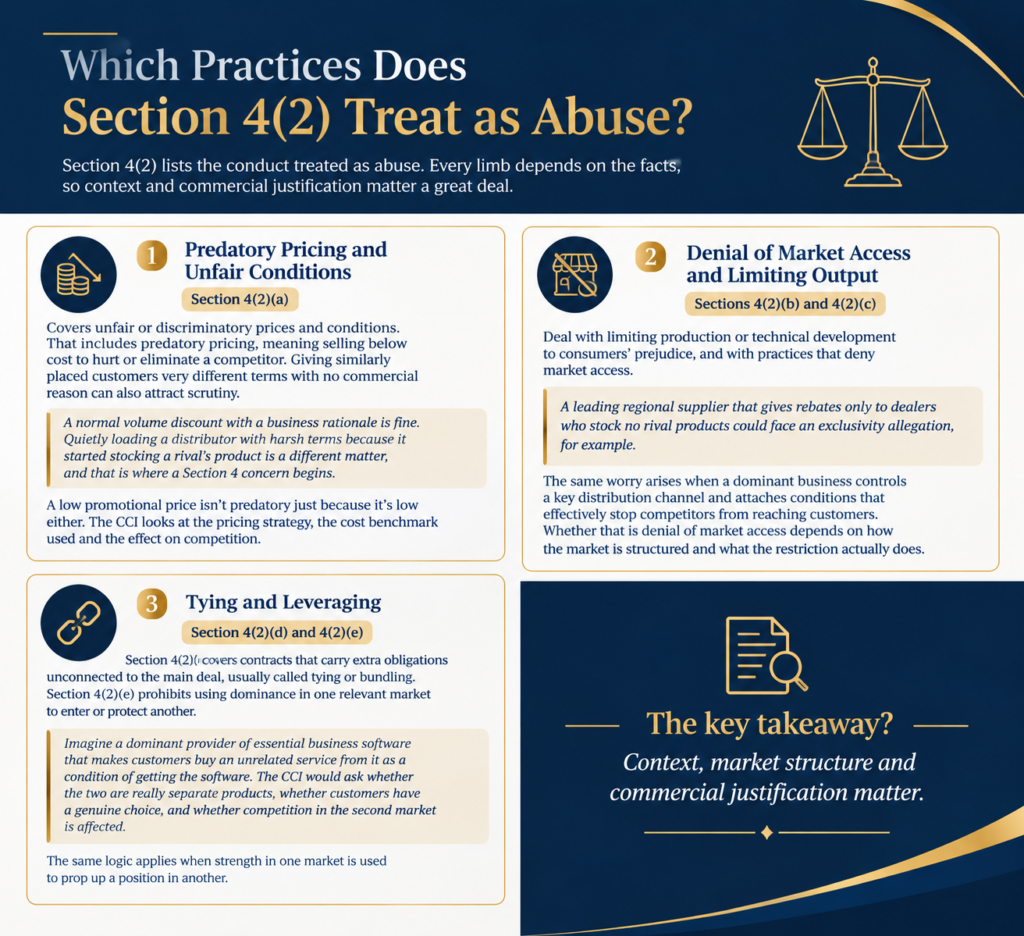
Section 4(2) lists the conduct treated as abuse. Every limb depends on the facts, so context and commercial justification matter a great deal.
Predatory Pricing and Unfair Conditions
Section 4(2)(a) covers unfair or discriminatory prices and conditions. That includes predatory pricing, meaning selling below cost to hurt or eliminate a competitor. Giving similarly placed customers very different terms with no commercial reason can also attract scrutiny.
A normal volume discount with a business rationale is fine. Quietly loading a distributor with harsh terms because it started stocking a rival’s product is a different matter, and that is where a Section 4 concern begins.
A low promotional price isn’t predatory just because it’s low either. The CCI looks at the pricing strategy, the cost benchmark used and the effect on competition.
Denial of Market Access and Limiting Output
Sections 4(2)(b) and 4(2)(c) deal with limiting production or technical development to consumers’ prejudice, and with practices that deny market access. A leading regional supplier that gives rebates only to dealers who stock no rival products could face an exclusivity allegation, for example.
The same worry arises when a dominant business controls a key distribution channel and attaches conditions that effectively stop competitors from reaching customers. Whether that is denial of market access depends on how the market is structured and what the restriction actually does.
Tying and Leveraging
Section 4(2)(d) covers contracts that carry extra obligations unconnected to the main deal, usually called tying or bundling. Section 4(2)(e) prohibits using dominance in one relevant market to enter or protect another.
Imagine a dominant provider of essential business software that makes customers buy an unrelated service from it as a condition of getting the software. The CCI would ask whether the two are really separate products, whether customers have a genuine choice, and whether competition in the second market is affected. The same logic applies when strength in one market is used to prop up a position in another.
What Is the Penalty for Abuse of Dominant Position?
Under Section 27, the CCI can direct the enterprise to cease and desist, modify its agreements and pay a penalty of up to 10% of its average turnover over the last three preceding financial years. Since the Competition (Amendment) Act, 2023, that turnover can include global turnover, and the CCI’s 2024 penalty guidelines explain how the base penalty is calculated. In serious cases Section 28 even allows a dominant enterprise to be broken up, and under Section 48 the people in charge of a company can be held responsible.
Appeals against CCI orders go to the National Company Law Appellate Tribunal (NCLAT) within 60 days, and from there to the Supreme Court. The 2023 amendment also brought in settlement and commitment mechanisms under Sections 48A and 48B. These are available in abuse cases but not for cartels.
So the fine is rarely the whole story. A CCI order can force changes to pricing, distribution arrangements and contract terms, which can matter as much as the money.
How Does a CCI Case Unfold?
Any person, consumer or trade association can give information to the CCI under Section 19, and the Central or a State Government can make a reference. If the CCI forms a prima facie view under Section 26(1), which it must now do within 60 days, the Director General investigates and submits a report. The parties are then heard and the CCI passes a final order. Interim relief is possible under Section 33.
If your business receives a CCI notice or a Director General query, preserve contracts, pricing records, internal communications and anything else relevant. Answering casually, or deleting records, can create fresh trouble on top of the original issue.
What Did the NCLAT Decide in the WhatsApp Case?
On 4 November 2025, the NCLAT upheld the CCI’s finding that WhatsApp’s 2021 privacy policy was an unfair “take-it-or-leave-it” condition under Section 4(2)(a)(i), because users had no meaningful way to opt out of data sharing with Meta. The penalty of about ₹213 crore stood, but the five-year ban on data sharing was set aside. Meta has appealed to the Supreme Court.
The takeaway for businesses is that data terms and other non-price conditions now sit squarely within an abuse of dominance analysis.
How Can Businesses Reduce Competition Law Risk in India?
A practical compliance review usually looks at the following:
- Define the relevant market for each product line, and be honest about your market share and whether you might be dominant.
- Audit discounts, rebates, exclusivity clauses and bundled offers against Section 4(2).
- Record the commercial reasons behind pricing and supply decisions. An objective justification is a recognised answer to a CCI allegation.
- Review customer and platform terms, especially data-sharing conditions, for one-sided clauses.
- Train your sales teams, and respond quickly to any CCI notice or Director General query, keeping settlement and commitment options in mind.
If an inquiry also raises criminal exposure, see our note on rights during a white collar crime investigation.
Markets, products, customer terms and pricing models keep changing, and each change can alter the analysis. Reviewing your position periodically, and again whenever commercial terms change, keeps this risk visible to management.
Talk to Our Competition and Antitrust Team
Anirudh Associates is a full-service pan-Indian corporate law firm, and competition and antitrust matters are a core part of our practice, alongside corporate and commercial litigation and white collar crime and compliance. If you are reviewing your pricing, distribution or platform terms, or have received a CCI notice or Director General query, reach out to us through the contact page on our website for a first conversation about your options.
Disclosure and disclaimer: Authored by Anirudh Suresh, Advocate, Enrolment No. KAR/1048/2013, Bar Council of Karnataka, Bengaluru; broad areas of practice: corporate and commercial law. This article is general legal information, not advice on any individual case. Outcomes depend on facts, documents, forum, evidence, limitation and judicial discretion, and none is guaranteed. Law stated as on 30 September 2026. No client or pending-matter information is disclosed. Please consult a qualified advocate on your own facts about abuse of dominant position.
Frequently Asked Questions
No. Dominance is lawful. Section 4 of the Competition Act, 2002 prohibits abusing it, for example through predatory pricing, exclusivity, tying or leveraging.
Under Section 27, the CCI can impose a penalty of up to 10% of average turnover for the last three preceding financial years. After the 2023 amendment, turnover can include global turnover.
Yes. Appeals lie to the NCLAT within 60 days, and thereafter to the Supreme Court.