Buying a home is one of the biggest financial commitments for most families. However, delayed possession, stalled projects, and repeated assurances from developers often leave homebuyers under significant financial and emotional stress. Fortunately, recent Supreme Court judgments have reinforced the legal rights of apartment allottees under the Insolvency and Bankruptcy Code, 2016 (IBC).
These judgments have clarified how homebuyers can enforce their rights when developers fail to deliver projects on time. Moreover, they have strengthened the position of homebuyers as financial creditors under Section 7 of the IBC. As a result, buyers now have greater confidence in pursuing insolvency proceedings before the National Company Law Tribunal (NCLT).
Table of Contents
Supreme Court IBC Homebuyer Judgments: Latest Legal Developments
Over the past few years, the Supreme Court IBC Homebuyer Judgments have significantly strengthened the rights of homebuyers affected by delayed real estate projects. Earlier, buyers often depended solely on consumer forums or RERA proceedings. However, the Insolvency and Bankruptcy Code has emerged as an effective legal mechanism for addressing developer defaults.
Section 7 of the IBC enables eligible homebuyers to initiate the Corporate Insolvency Resolution Process (CIRP) against developers who fail to fulfil their contractual obligations. Consequently, developers face structured insolvency proceedings, creating greater accountability and improving the chances of resolution, possession, or settlement.
Furthermore, several landmark judgments have clarified how insolvency proceedings should protect genuine homebuyers while balancing the interests of lenders and other stakeholders.
Understanding Section 7 IBC for Homebuyers
Section 7 of the Insolvency and Bankruptcy Code recognises apartment allottees as financial creditors. Therefore, the amounts paid by homebuyers are treated as financial debt rather than mere advance payments.
As a result, eligible homebuyers can initiate insolvency proceedings before the NCLT when developers commit financial defaults.
Why Homebuyers Are Financial Creditors
This legal recognition provides several important protections.
- Homebuyers can initiate CIRP against defaulting developers.
- They become part of the Committee of Creditors after admission of the case.
- They receive statutory protection during the insolvency resolution process.
- They gain voting rights through authorised representatives.
If you want to understand the complete filing process, eligibility, and required documents, read our detailed guide on How Apartment Allottees Can Recover Delayed Possession. Consequently, homebuyers now enjoy stronger legal standing than they did before the 2018 amendments to the IBC.
Jaypee Infratech Case: A Landmark Victory for Homebuyers
The Jaypee Infratech insolvency remains one of the most significant examples of how the IBC protects homebuyers.
More than 20,000 buyers invested in projects located along the Yamuna Expressway. Unfortunately, construction delays continued for several years, leaving thousands without possession.
The CIRP commenced in August 2017 after IDBI Bank initiated insolvency proceedings for defaults exceeding ₹526 crore. Subsequently, homebuyers collectively secured approximately 56.63% voting rights in the Committee of Creditors, giving them substantial influence over the resolution process.
In March 2023, the NCLT approved the Suraksha Group’s resolution plan. Consequently, thousands of homebuyers received renewed hope for completing long-delayed projects.
Moreover, the Tribunal directed the Interim Resolution Professional to establish an implementation monitoring committee that included lenders, the successful resolution applicant, and authorised representatives of homebuyers.
Key Takeaways from the Supreme Court Decision
The Supreme Court further strengthened buyer protections in September 2024.
The Court directed that eligible homebuyers who had paid more than 80% of the consideration should receive the option of flat allotment within a specified timeline. Additionally, buyers seeking refunds remained entitled to recover their admitted claims even if they had not filed separate refund applications.
Most importantly, the Court recognised that verified homebuyer claims deserve meaningful relief through possession wherever feasible rather than limiting buyers to reduced monetary recoveries.
Adani-Vedanta Dispute and the Commercial Wisdom Principle
Another important development emerged from the insolvency proceedings involving Jaiprakash Associates Limited.
After the company entered CIRP in June 2024, the Committee of Creditors approved Adani Enterprises’ resolution plan with overwhelming voting support. Subsequently, Vedanta challenged the approval, arguing that its financial offer was higher.
However, both the NCLAT and the Supreme Court upheld the Committee of Creditors’ decision.
Why the Judgment Matters?
The Supreme Court reaffirmed an important insolvency principle.
The objective of the IBC is not merely to accept the highest financial bid. Instead, the Committee of Creditors has the commercial authority to approve the most feasible and viable resolution plan.
Therefore, courts generally avoid interfering with commercial decisions unless statutory violations occur.
Important Legal Principles Established by the Supreme Court
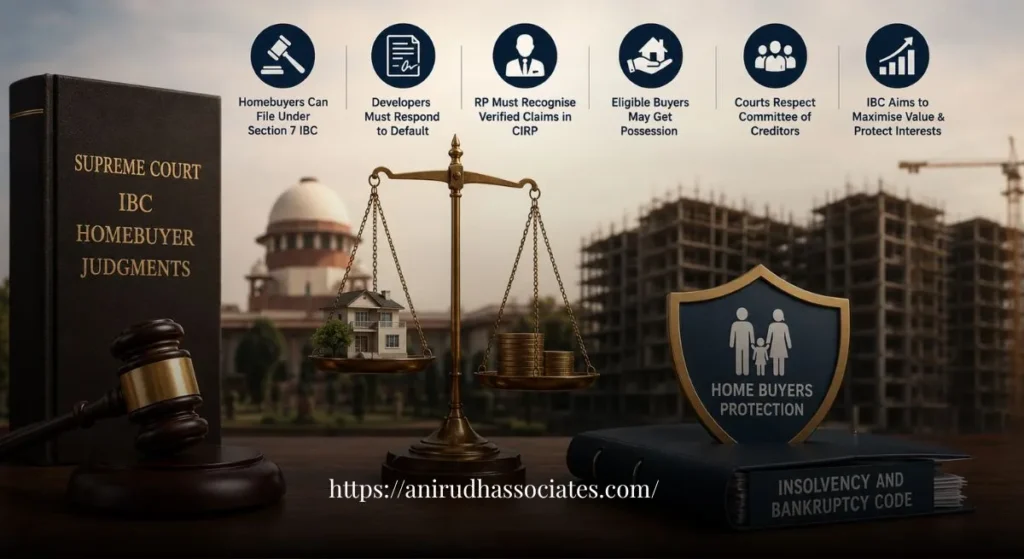
Collectively, these Supreme Court IBC Homebuyer Judgments have established several important legal principles.
- Genuine homebuyers may invoke Section 7 of the IBC when statutory requirements are satisfied.
- Developers must respond once buyers establish a prima facie case of default.
- Resolution Professionals must recognise verified claims during CIRP.
- Eligible homebuyers may receive possession where projects remain viable.
- Courts continue to respect the commercial wisdom of the Committee of Creditors.
- Insolvency proceedings aim to maximise value while protecting stakeholder interests.
Consequently, these judgments have considerably strengthened homebuyers’ legal position.
Key Challenges Under Supreme Court IBC Homebuyer Judgments
Although these judgments provide significant relief, homebuyers should still proceed strategically.
For example, the Supreme Court clarified in January 2026 that Resident Welfare Associations and maintenance societies cannot independently intervene in insolvency proceedings because they lack statutory standing.
Instead, individual homebuyers must submit and verify their own claims or participate through authorised representatives appointed under the IBC framework.
Therefore, maintaining proper documentation remains essential throughout the process.
Practical Steps Before Filing an IBC Claim
Homebuyers can improve their legal position by acting promptly instead of waiting indefinitely.
Before initiating proceedings, buyers should:
- Preserve allotment letters and builder-buyer agreements.
- Maintain payment receipts and bank statements.
- Save emails, notices, brochures, and project advertisements.
- Monitor CIRP announcements and file claims within prescribed timelines.
- Participate actively through authorised representatives during creditor meetings.
- Evaluate whether possession or refund better serves their financial interests.
Essential Documents to Preserve
Strong documentation substantially improves the chances of successful claim verification.
Maintain:
- Allotment Letter
- Builder Buyer Agreement
- Payment Receipts
- Bank Statements
- Construction Updates
- Builder Correspondence
- Possession Commitments
- Demand Notices
Role of Homebuyers' Associations During CIRP
Although Resident Welfare Associations cannot independently pursue insolvency proceedings, they still play an important supporting role.
For instance, associations can coordinate communication among buyers, organise meetings, maintain payment records, and assist authorised representatives during the CIRP.
However, every individual homebuyer must independently ensure that the Resolution Professional admits their claim.
Why Professional Legal Guidance Matters?
IBC proceedings involve detailed procedural requirements, strict timelines, and extensive documentation.
Therefore, experienced insolvency lawyers can assist homebuyers by preparing Section 7 applications, verifying claims, representing buyers before the NCLT and NCLAT, and advising on the most effective legal strategy.
Moreover, professional guidance helps buyers avoid procedural mistakes that could delay or weaken their claims.
If you are considering insolvency proceedings against a defaulting developer, consult experienced Corporate Lawyers for IBC Petitions in Bangalore to evaluate your case, prepare the necessary documentation, and represent your interests before the NCLT and NCLAT.
Final Takeaways from the Supreme Court IBC Homebuyer Judgments
The recent Supreme Court IBC Homebuyer Judgments have significantly strengthened the legal protections available to homebuyers under the Insolvency and Bankruptcy Code.
These rulings reaffirm that genuine homebuyers are financial creditors with enforceable rights during insolvency proceedings. Furthermore, the Supreme Court has clarified important principles regarding possession, refunds, claim verification, and the commercial wisdom of the Committee of Creditors.
If your builder has delayed possession or abandoned a project, these judgments demonstrate that the IBC provides a structured and effective legal remedy. Acting promptly and pursuing the appropriate legal strategy can substantially improve your chances of securing possession or recovering your investment.