
A divorce case rarely turns on a single ground. Instead, it often involves related issues, including custody, maintenance, safety, and financial support. The applicable Indian laws effectively address each of these issues, while the specific ground for divorce can significantly influence how the court approaches the wider dispute at hand.
What Actually Decides a Divorce Case in India?
Choosing the right ground for divorce matters, but it does not determine the outcome by itself. Courts actively consider whether the spouse’s conduct meets the applicable legal test, whether sufficient evidence backs the allegations, whether the evidence remains consistent, and whether the surrounding circumstances support the claim.
Therefore, simply alleging something does not establish sufficient grounds for a divorce to be granted. This is why two similar cases, which lawyers handle and involve the same ground for divorce, may ultimately result in different outcomes.
Legal Grounds for Divorce Under the Hindu Marriage Act, 1955
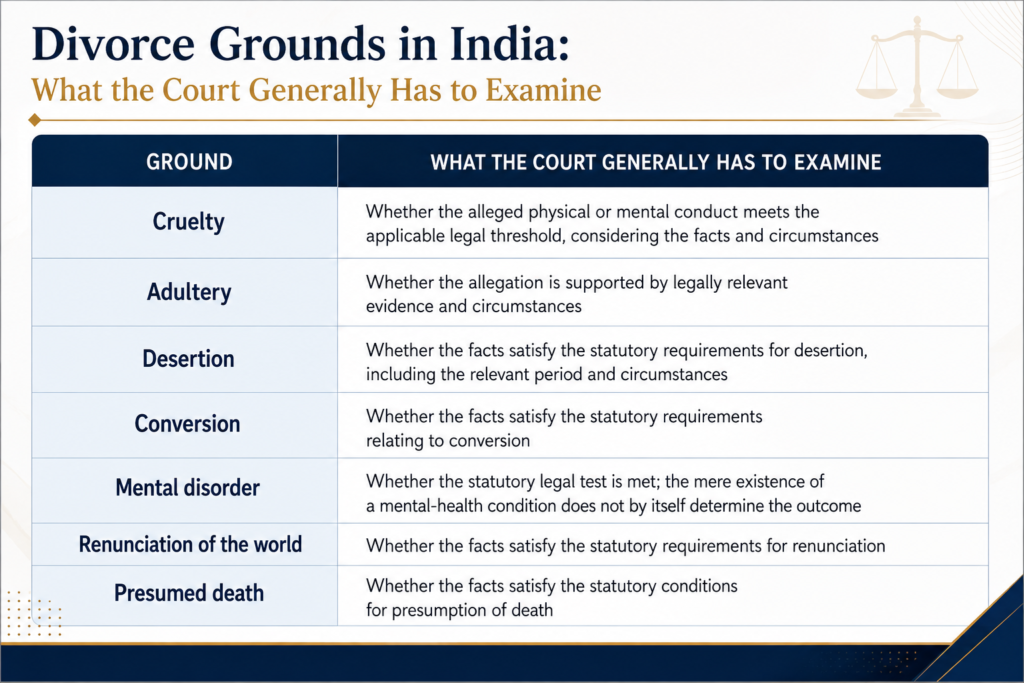
Any spouse can apply for divorce on any of the following grounds as per the Hindu Marriage Act of 1955:
- Cruelty: Physical, verbal, mental torture or harassment and any conduct of a spouse that makes the other spouse live together with them in misery or cruelty.
- Adultery
- Desertion for a continuous period
- Conversion to another religion
- Mental disorder
- Renunciation of the world
- Presumed death (no news of the spouse for seven years or more)
Which Section of the Hindu Marriage Act Covers Divorce?
Briefly explain that the relevant authorities address the grounds in section 13 of the Hindu Marriage Act, 1955, and that the provisions for divorce by mutual consent are outlined in section 13B of the same act.
Why Cruelty Is the Most Litigated Ground
Cruelty remains one of the most frequently litigated grounds because courts assess it broadly in light of the facts and circumstances of each case. In Samar Ghosh v. Jaya Ghosh, the Supreme Court outlined several principles that continue to inform legal analysis. Even so, the outcome depends on the specific facts and the evidence presented by the parties.
Evidence To Prove Cruelty
The determination of the required evidence depends on the specific facts and the grounds for divorce. Lawyers often rely on various documents, detailed records, witness testimony, and other relevant materials that help establish the alleged conduct.
- Emails, messages, letters, or other communications between the spouses
- Medical records relating to injuries or treatment
- Statements from people who witnessed the relevant events
- Bank statements, income records, or other financial records
- Police complaints, FIRs, or incident reports
- Photos, recordings, or any other evidence relevant to the case
The aim is not to gather documents simply for the sake of volume. Each document should help a specific fact, such as the nature of the alleged conduct, when it occurred, how often it occurred, or what consequences followed. Relevant communications, dates, incidents, and surrounding circumstances can all strengthen the factual record.
How Courts Assess Evidence in a Divorce Case
A divorce petition may include serious allegations, but the strength of the case depends on whether the available evidence can establish those allegations.
Depending on the specific ground the petitioner raises, courts will consider the following:
- Contemporaneous communications: messages, emails, letters, or other communications that relate to the alleged conduct.
- Medical records: where physical injury or treatment plays a role in the allegation.
- Witness evidence: testimony from individuals who possess direct knowledge of the relevant events.
- Financial records: where parties dispute financial control, maintenance, income, or assets.
- Police or incident records: documentation of relevant complaints or reported incidents.
- Other documentary evidence: records that assist in establishing the timing, frequency, context, or consequences of the disputed conduct.
Litigants should organize their evidence around the specific facts that the evidence needs to establish. A large volume of documents does not inherently offer stronger support than a smaller set of evidence that is relevant, credible, and properly contextualized.
Mutual Consent Divorce: Faster, But Not Simpler
When both spouses agree to separate, a mutual consent divorce is usually quicker and less adversarial. But “mutual consent” rarely means “nothing else to settle.” Couples still need to finalize:
- Custody and visitation
- Maintenance or one-time settlement
- Return of stridhan (a wife’s personal property/gifts)
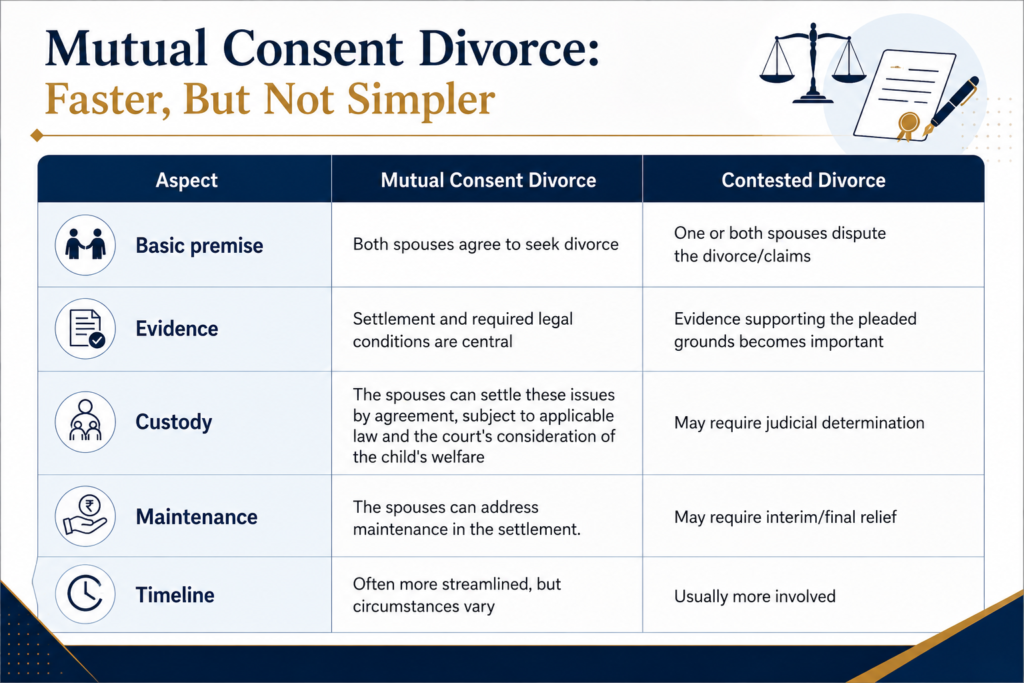
If the parties do not draft the settlement with clear and enforceable terms, one party may later try to reopen the dispute. This is where legal drafting quality matters as much as the agreement itself.
What Should a Divorce Settlement Address?
Include:
- maintenance/alimony
- child custody
- visitation
- education and child-related expenses
- stridhan
- property/asset arrangements where applicable
- pending proceedings
- payment timelines
- documents/handovers
- consequences of non-compliance
Child Custody: The Child’s Welfare Comes First
Courts don’t award custody as a reward to either parent. The child’s welfare is the deciding factor, weighed against:
- Age and emotional needs of the child
- School and living stability
- Each parent’s financial capacity and caregiving ability
Outcomes vary sole custody with visitation rights, or a shared parenting arrangement depending on what genuinely serves the child.
What Does “Child’s Welfare” Mean in Practice?
The welfare principle focuses on what arrangement best serves the child’s overall interests. Courts may consider the child’s age, educational and emotional needs, safety, stability, and each parent’s ability to provide appropriate care and support.
The outcome can therefore differ from one family to another. A parent should not assume that income alone, or being the child’s primary caregiver alone, automatically determines custody.
Maintenance: More Than Survival Money
A financially dependent spouse can claim interim or permanent maintenance. Courts look at:
- Income and earning capacity of both spouses
- Standard of living during the marriage
- Needs of the spouse and any children
Maintenance disputes often turn urgent when one spouse controls family finances or deliberately delays payment, which is why interim relief applications matter early in the case, not as an afterthought.
What Can Affect a Maintenance Claim?
- income and earning capacity
- actual needs
- standard of living
- dependants
- liabilities
- assets
- children’s expenses
- financial disclosure
- existing support
Also make clear that maintenance is not determined by a single formula in every proceeding.
When Domestic Violence Overlaps With Divorce
Where cruelty is severe, a spouse may also have remedies under the Protection of Women from Domestic Violence Act, 2005. This law allows for:
- Protection orders
- Residence orders
- Monetary relief and compensation
- Custody-related relief
A pending domestic violence complaint can directly affect strategy in the divorce case, including which interim remedies the court may grant and how the parties present their evidence.
Building Your Case: What to Organize Early
Before filing, prepare:
Good documentation early on protects both the legal case and personal safety and reduces avoidable delay later.
Common Mistakes That Can Weaken a Divorce Case
- making broad allegations without specifics
- deleting relevant messages
- exaggerating claims
- relying on illegally obtained material
- ignoring financial disclosures
- agreeing to vague settlement terms
- assuming custody follows income
- waiting until the end of the case to address urgent interim relief
When Should You Speak to a Family Lawyer?
Mention situations involving:
- immediate safety concerns
- children
- financial dependency
- substantial assets
- domestic violence proceedings
- disputed evidence
- complex settlement terms
- multiple proceedings
Frequently Asked Questions
Is mutual consent divorce always faster than a contested one?
Generally yes, but custody, maintenance, or property disputes can still extend the timeline even with mutual consent.
Can maintenance be claimed before the divorce is finalized?
Yes, interim maintenance can be sought while the case is pending, so a dependent spouse isn’t left without support during litigation.
Does a domestic violence complaint affect a divorce case?
It can. It may support a cruelty claim and can influence interim custody or residence relief while the divorce is ongoing.