
Why Does the Indian Contract Act Create Interpretive Uncertainty for Indemnity Clauses?
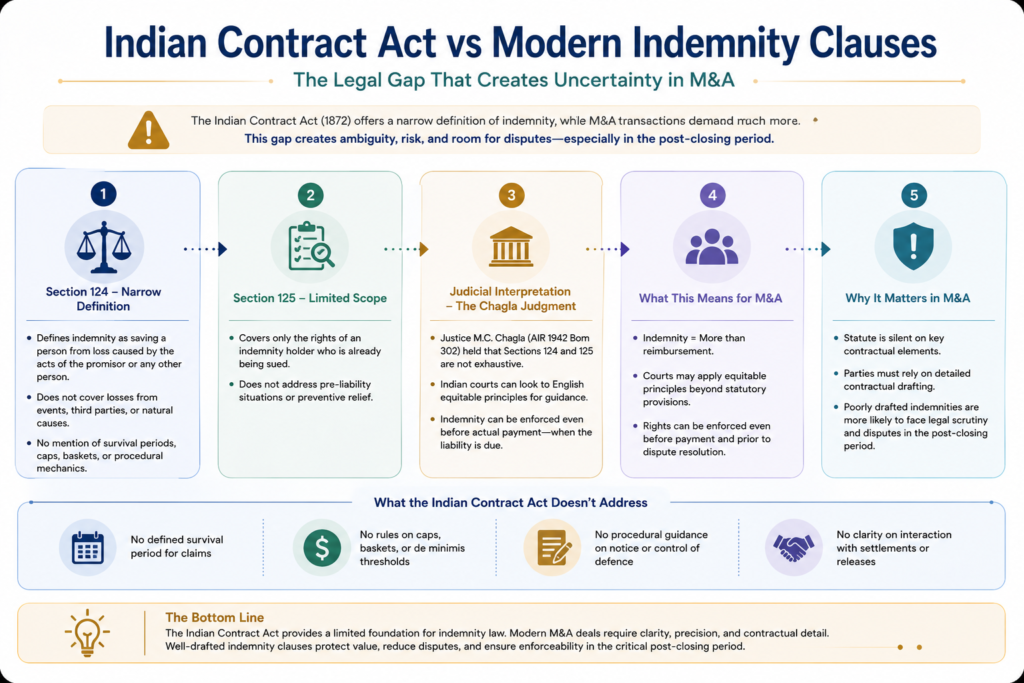
The initial difficulty occurs in Section 124 of the Indian Contract Act, 1872 which states that a contract of indemnity is a contract to save a person from any loss caused by the acts of the promisor or of any other person. Thus, in other words, it does not cover losses which do not arise from the acts of any person or thing. It also says nothing about survival periods, caps, baskets, or the procedural mechanics that a modern M&A indemnity clause relies on. Section 125 is equally narrow, covering only the rights of an indemnity holder who is already being sued.
This tension is not new. It has been dealt with by Justice M.C. Chagla while considering the Bombay High Court decision in Gajanan Moreshwar Parelkar v. Moreshwar Madan Mantri (AIR 1942 Bom 302). In a suit for a declaration regarding the liabilities between an indemnifier and an indemnitee under an escrow deed, he held that Sections 124 and 125 are “not exhaustive of the Indian law of indemnity”. He further provided that the Indian courts have to look to the English equitable jurisprudence for indemnity law. As such, there arises a “right in the indemnified party to compel the indemnifier to make him whole in respect of a liability which has become absolutely due to the indemnitee, even before any actual payment of compensation to the indemnitee out of the indemnifier’s pockets”. The implications of such a finding on indemnity disputes in M&A transactions in the post-closing period are often glossed over by the parties who consider indemnity to merely mean reimbursement.
What Section 124 Leaves Unanswered
- No defined survival window for a claim
- No express treatment of caps, baskets, or de minimis thresholds
- No procedural mechanics for claim notice or control of defence
- No guidance on how indemnity interacts with a later settlement or release
These gaps are the reason why well-drafted Indian SPAs tend to utilise extensive contractual formulations instead of relying on the bare bones of the statute and why poorly-drafted agreements are often challenged and/or scrutinised in court.
How Do Indemnity Clauses in Indian M&A Interact With a Full and Final Settlement?
A commercially important question that comes up constantly in practice: does a contractual indemnity survive a “full and final settlement” discharge?
Picture a typical fact pattern. The SPA includes an indemnification provision with survival periods of four and one-half to nine years for general and fundamental or tax representations, respectively. In addition, the SPA provides that, following the closing, the parties will resolve any outstanding disputes, and the resulting settlement agreement shall include a broad release of “all claims and liabilities arising out of or in connection with the SPA.”
Does that language extinguish the buyer’s right to later invoke the indemnity for a breach of representation discovered afterward? The answer turns on whether the indemnity is an independent covenant or merely derivative of the underlying representations.
According to the Indian Contract Act, specifically Section 73, damages for breach cannot exceed those that could have been anticipated at the moment of contract formation. However, an indemnity, on the other hand, if properly worded, provides a separate obligation that is not bound by the constraints of Section 73. As such, it can be applied to a wide variety of situations, including indirect loss, third-party claims, and any other liabilities, which could not be covered by Section 73. The practical takeaway: indemnity clauses in Indian M&A, when drawn as independent covenants with survival language, survive a general discharge, unless the discharge language explicitly and unequivocally extinguishes the indemnification right.
One of the most common and costly drafting errors we see at the firm literally dozens of instances is that a settlement, intended to cover one dispute, inadvertently releases the parties from a subsequently discovered indemnification obligation for an unrelated dispute.
What Does the 2026 Supreme Court Ruling Mean for Indemnity Enforcement?
The Supreme Court’s April 2026 decision in VPS Healthcare Private Limited v. Prabhat Kumar Srivastava (2026 INSC 361) has meaningfully clarified this landscape, and it’s the case every dealmaker negotiating an Indian SPA right now should know.
The dispute traced back to VPS Healthcare’s acquisition of Rockland Hospitals (later renamed Medeor Hospitals) from its founding promoters. Under a SIAC consent award, the promoters had undertaken to ensure that no liability from a pending EU arbitration claim would ever be recovered from the buyer. When a court later ordered a deposit connected to that claim, a dispute arose over when the indemnity actually became enforceable. The Delhi High Court deferred enforcement, holding that the obligation would crystallise only once the matter was finally confirmed by the highest court of appeal.
The Supreme Court Justices S.V.N. Bhatti and Prasanna B. Varale reversed that reading, holding that a present, absolute obligation had already crystallised through the stay order requiring the deposit, and that the indemnity could not be deferred under the guise of awaiting appellate confirmation. The Court flagged the logical trap in the High Court’s approach: if the indemnity were triggered only after Supreme Court confirmation, the indemnifier could simply choose never to appeal perpetually avoiding the obligation and reducing the clause to a nullity.
That reasoning reinforces the Gajanan Moreshwar principle in modern, transaction-specific terms: indemnity is protection, not reimbursement. For a founder or promoter negotiating an exit, the takeaway is that the language of your indemnity clause determines exactly when liability crystallises, and any ambiguity will now be read against the party trying to defer payment.
How Does the Indian Approach Differ From Common Law Jurisdictions?
American SPAs typically build in detailed procedural mechanics that claim notice requirements, control-of-defence provisions, and tiered survival periods, with general representations surviving 12 to 24 months and fundamental representations surviving until the relevant statute of limitations runs out. Indemnification caps in the US market typically sit at 10 to 20 percent of purchase price, backed by escrow holdbacks of 10 to 15 percent.
Indian M&A practice has borrowed much of this architecture, but enforcement diverges in three specific ways.
1. Survival Periods vs. the Limitation Act
Where American courts generally honour contractually agreed survival periods as private limitation clauses, Indian courts may look past the contract to the Limitation Act, 1963, which prescribes a three-year period for most contractual claims. This creates a real risk of unexpected exposure for sellers who assumed their indemnity window had already closed.
2. Pre-Loss Enforcement
The Indian position is, if anything, more protective of the indemnity holder than many US jurisdictions, where actual loss is often a precondition to recovery. As Gajanan Moreshwar and now VPS Healthcare confirm, Indian law allows enforcement once liability is absolute before any money has actually left the indemnity holder’s account.
3. GST Treatment of Indemnity Payments
Whether indemnity payments attract GST remains genuinely under-drafted in most Indian SPAs. Ambiguous structuring here can expose both parties to tax disputes that quietly erode the entire economic purpose of the indemnity.
What Should Founders and Promoters Insist on When Negotiating Indemnity Clauses in Indian M&A?
Whether you’re on the buy-side or the sell-side, a few safeguards follow directly from where the law currently stands:
- Draft the indemnity as an independent covenant (surviving closing, assignment and termination) by including language to that effect and avoid relying solely on the representations and warranties and a remedy for their breach;
- Fix survival periods with precision and insert language making it clear that any claim duly notified within the applicable survival period survives the closing, even if it ultimately takes longer than the survival period to resolve.
- Use “hold harmless” language, not “compensate” or “make good.” Indian courts read these phrases differently, and the wrong choice can be the difference between protection at the point liability accrues and having to pay out of pocket first, then seek reimbursement.
- Never sign broad release language in a post-closing settlement without an express carve-out preserving your indemnification rights. A settlement that looks like a clean resolution of one dispute can silently extinguish protection for an unrelated, later-discovered one this is precisely the trap discussed in our review of commercial contract enforcement risk.
- Address the taxation of indemnifications payments upfront in the SPA itself and avoid disputes over whether such reimbursement is subject to GST.
Conclusion
Indemnity clauses in Indian M&A transactions represent a confluence of a nineteenth-century statute, equitable doctrines deeply embedded in English common law, and twenty-first century deal structuring. The 2026 decision of the VPS Healthcare case marks an important step toward coherence, but the challenge remains in reconciling indemnity laws in India with modern commercial practice..
If you’re entering a transaction as a founder selling your company, a promoter exiting, or a buyer acquiring a target, the indemnity clause deserves the same scrutiny you give to valuation. Get it right at the drafting stage and it protects you when things go wrong. Get it wrong, and no amount of negotiation on price will make up for a clause that fails in court.
Anirudh Associates provides advice to founders, promoters, and acquirers on matters relating to M&A structuring, SPA and commercial contract drafting, and private equity and joint venture transactions in India. For any query related to negotiating an indemnity clause or post-closing dispute resolution, contact our lawyers.