The one pitfall regarding IP vesting in founder-led startups that causes most PE/VC exits to fail, in my experience, is rarely discussed. If you are a founder who has built something valuable before incorporation, or a promoter attempting a strategic sale, there is a high chance that the deal will hit a roadblock on the basis of your IP assignment. Investors write big cheques assuming that everything sold belongs to the company, but the acquirer discovers, sometimes too late, that the assignment chain is missing a vital link. It is rarely intentional – the drafting errors and assumptions regarding the ownership and assignment of rights under the Copyright Act, 1957 are the result of misplaced confidence or ignorance of the law.
Why does Indian copyright law create a default ownership problem for startups?
The default position under Section 17 of the Copyright Act, 1957 is that the author of a work is its first owner, save for works made in the course of employment under a contract of service, which belong to the employer. When considered through the prism of a typical founder-led startup, the implication is that pre-incorporation works – which for most tech-first startups typically encompasses the entire body of code, algorithms, and IP developed – belong to the individual founder(s) and not the company. This is a direct result of the absence of an employer-employee relationship at the time of creation.
For IP vesting in founder-led startups, this creates a hurdle since the company must acquire ownership of such pre-incorporation works via assignment. Even more pertinent is the Copyright Act’s detailed requirements for valid assignments, most of which are rarely addressed in founders’ agreements, share purchase agreements, or even detailed IP assignments by individual assignors.
Relatedly, if you’re a founder looking to execute a founders’ agreement for an early-stage company, see our detailed guide to structuring a founders’ agreement covering IP, vesting, and other key clauses common to such documents.
What does Section 19 of the Copyright Act require for a valid assignment?
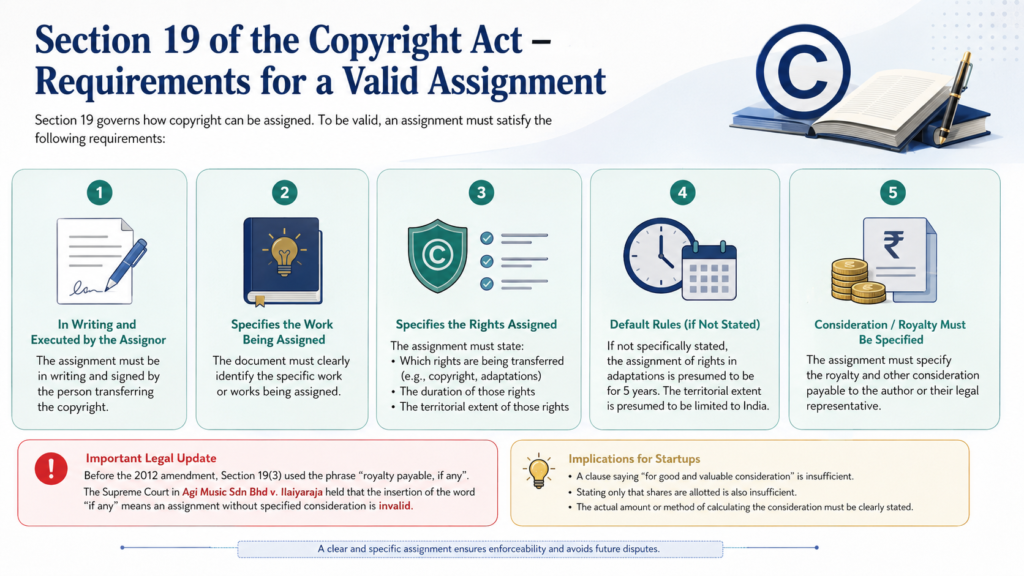
A brief recap of the requirements under Section 19 is as follows:
- The assignment must be in writing and executed by the assignor.
- It must specify the work being assigned.
- It must specify the rights assigned – copyright, adaptations, etc., their duration, and their territorial extent.
- In the case of adaptations, the assignment’s duration is presumed to be five years and, in the case of territorial extent, confined to India, if not specifically stated to the contrary.
- Most crucially for IP vesting in founder-led startups, the assignment must specify the royalty and other consideration payable to the author or their legal representative, as per the amendment in 2012.
It must be noted that prior to the amendment, Section 19(3) read “royalty payable, if any”. As interpreted in the case of M/s. Agi Music Sdn Bhd v. Ilaiyaraja, the insertion of the word “if” in the amended Section 19(3) makes an assignment that does not specify consideration or royalty invalid, unless the consideration is separately mentioned.
In the context of IP vesting in founder-led startups, this means that a consideration clause that merely states something like ‘for good and valuable consideration’ is insufficient, since the actual amount payable is not indicated. It is also insufficient to rely on the shares allotted to the founder(s) as consideration.
What are the considerations for future works created?
Section 18(1) Copyright Act allows for assignment of copyright in a future work, which only comes into effect when such a work is created. This means that, in the case of IP vesting in founder-led startups, a founders’ agreement executed at the time of incorporation can assign both existing and future works. The latter will come into existence when such a future work is created – for example, features iterated upon by the development team, or new works created by them.
As per the 2012 Copyright Amendment Act, however, when such a future work comes into existence, the assignment will not extend to any mode of exploitation that did not exist or was not commercially exploited at the date of assignment, unless specifically stated. This implies that an IP assignment executed at the time of a PE/VC exit, when the startup is selling itself to another corporate entity, would not extend to modes of exploitation that have emerged since its execution.
Similarly, a future work assignment executed at the time of incorporation may not cover certain categories of work that fall under the definition of “future works” such as works created using AI.
What are the common drafting pitfalls during the due diligence for SEBI registered startups’ acquisitions?
During the due diligence for an acquisition by SEBI-registered AIFs, the buyer’s counsel will examine with a fine-toothed comb the IP ownership chain for any inconsistencies and title defects. Common pitfalls that crop up during such due diligence relate to consideration, lapse of assignment, exceptions for contractors/freelancers, and modes of exploitation.
Consideration: A copyright assignment that merely recites the phrase “for good and valuable consideration” is not sufficient to satisfy the requirements of Section 19(3), particularly with the 2012 copyright amendment. The buyer will challenge such consideration clauses during due diligence, and it is far more expensive to cure such title defects at the eleventh hour than remedy them beforehand.
Lapse: As per Section 19(4), if the assignment is not exercised within one year of its execution, it lapses automatically, save for what is expressly stated to the contrary.
Contractors: Work done by freelance contractors and vendors must be assigned via separate assignments, since, in the context of Section 17 employer exception, they are not employees. At best, such works constitute the property of the freelancer until assigned to the company.
Modes of exploitation: As covered above, Section 18(1) and the 2012 Copyright Amendment Act state that, for copyright assignments executed before such a medium comes into commercial exploitation, the assignment will not extend to it by virtue of the assignment.
What should founders and promoters insist on for IP vesting before a funding round or exit?
If you are a founder or promoter attempting a PE/VC secondary sale or an IPO, or even considering a Series A funding raise, there is no better time to address the issues with your IP assignment deed. If the assignment deed is a part of your founders’ agreement, it is crucial to ensure that it is a standalone document that satisfies all requirements under Section 19 of the Copyright Act. Here are the bare minimum requirements that you should include in an IP assignment agreement:
- For existing works created by the founder(s), the agreement must specify each work by name/description, all rights assigned under Section 14, the assignment’s duration (ideally, co-extensive with the copyright term), and its territorial extent (ideally worldwide). The agreement should specify consideration (even if nominal) payable to the founder(s) and their legal representatives, along with a carve-out that the assignment will not lapse under Section 19(4) unless expressly stated to the contrary.
- For future works created by the founder(s), the agreement should describe each category of works that fall under the definition of “future works” with an express assignment of all rights. It should also mention all modes of exploitation, including those that have come into commercial exploitation since the date of execution, and explicitly state that the assignment extends to them. This is crucial to satisfy the requirements under the 2012 Copyright Amendment Act.
- For works done by vendors and contractors, an IP assignment clause in a master services agreement is rarely sufficient to satisfy the requirements under the Copyright Act. Ideally, each services agreement should contain an IP assignment as a separate exhibit that describes the specific deliverables, contains a consideration clause, and is executed by both parties at the time of signing.
- Founders preparing or reviewing an assignment deed can refer to our IP assignment deed checklist for startups for details. Alternatively, contact us for a pre-exit IP audit before the buyer’s counsel initiates diligence.
Conclusion
IP vesting in founder-led startups is one of those issues that starts with incorporation and festers through successive funding rounds until it erupts with the PE/VC exit. The requirements under Sections 17, 18, and 19 of the Copyright Act, 1957, as amended, are far from onerous – but they are often overlooked in the scramble to finalize term sheets, share purchase agreements, or founders’ agreements. As a founder preparing for an exit, you should treat your IP assignment chain with the same due diligence as your cap table because just as one misplaced option strike price can ruin a billion-dollar deal, so too can the missteps enumerated above.