
What Is a Non-Compete Clause?
A non-compete clause is a contractual provision that restricts a party from competing with another party in a specified manner.
Depending on the agreement, it may attempt to restrict a person from:
- Starting a competing business
- Joining a competitor
- Operating a similar business
- Approaching certain customers
- Soliciting employees
- Using confidential business information
- Competing within a specified territory
- Competing for a specified period
However, inserting these restrictions into a contract does not mean that they are enforceable in all cases. The rights and legal position will depend on the type of contract, when the restrictions are in place, what interest is being protected and how well drafted the clause.
Section 27 of the Indian Contract Act and Restraint of Trade
The law discusses the things in relation to agreements in restraint of trade under section 27. As a general rule, an agreement that prohibits any person from carrying on lawful profession, trade or business is void, with the only exception being where it relates to the sale of goodwill, and this statute provides for that. This is why non-compete clauses create hindrance and need careful drafting in India.
The question is not simply whether both parties voluntarily signed the agreement. The more important question is whether the particular restriction falls within a legally permissible arrangement.
Indian courts have also distinguished between restrictions that operate during an existing employment relationship and restrictions that attempt to continue after employment has ended.
That distinction becomes particularly important when reviewing employment contracts.
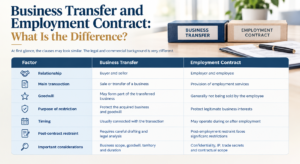
Business Transfer and Employment Contract: What Is the Difference?
At first glance, the clauses may look similar. The legal and commercial background is very different.
| Factor | Business Transfer | Employment Contract |
| Relationship | Buyer and seller | Employer and employee |
| Main transaction | Sale or transfer of a business | Provision of employment services |
| Goodwill | May form part of the transferred business | Generally not being sold by the employee |
| Purpose of restriction | Protect the acquired business and goodwill | Protect legitimate business interests |
| Timing | Usually connected with the transaction | May operate during or after employment |
| Post-contract restraint | Requires careful drafting and legal analysis | Post-employment restraint faces significant restrictions |
| Important considerations | Business scope, goodwill, territory and duration | Confidentiality, IP, trade secrets and contractual scope |
Non-Compete Clauses in a Business Transfer
Consider a simple example.
A founder has operated a technology business for 15 years. The buyer acquires the business, including its customer relationships, brand value, goodwill and operating assets.
As part of the transaction, the founder agrees not to immediately establish a competing business using the same commercial relationships and goodwill.
The buyer’s concern is understandable.
It has paid for the business. If the seller immediately sets up an identical competing operation and targets the same customers, the value of the acquisition could potentially be undermined.
This is why non-compete provisions frequently appear in:
- Business Transfer Agreements
- Share Purchase Agreements
- Asset Purchase Agreements
- Slump sale transactions
- Founder exit arrangements
- M&A documentation
Identifies non-compete provisions as one of the matters that may be addressed in business transfer agreements. But this does not mean that every restriction in a business transfer agreement is automatically valid.
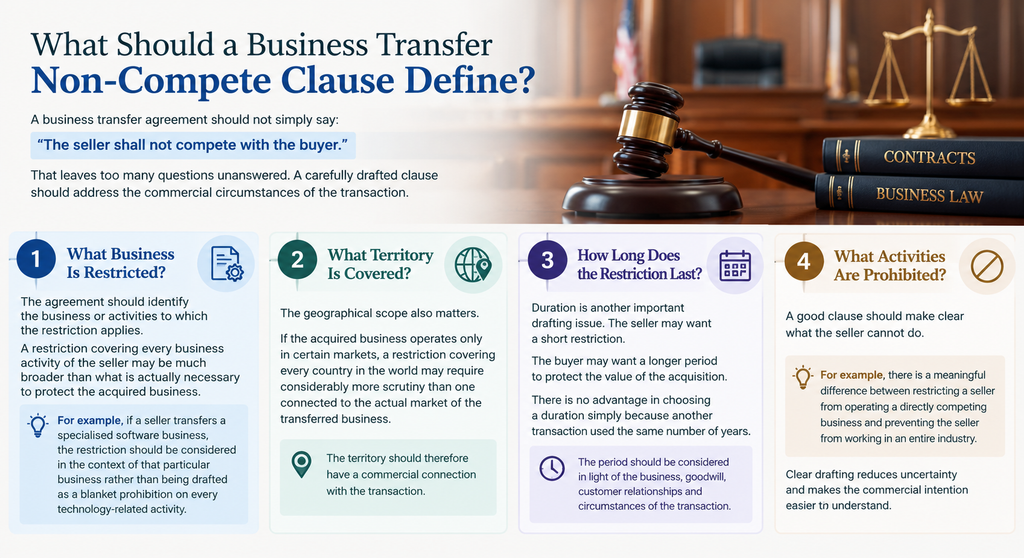
What Should a Business Transfer Non-Compete Clause Define?
A business transfer agreement should not simply say: “The seller shall not compete with the buyer.”
That leaves too many questions unanswered.
A carefully drafted clause should address the commercial circumstances of the transaction.
1. What Business Is Restricted?
The agreement should identify the business or activities to which the restriction applies.
A restriction covering every business activity of the seller may be much broader than what is actually necessary to protect the acquired business.
For example, if a seller transfers a specialised software business, the restriction should be considered in the context of that particular business rather than being drafted as a blanket prohibition on every technology-related activity.
2. What Territory Is Covered?
The geographical scope also matters.
If the acquired business operates only in certain markets, a restriction covering every country in the world may require considerably more scrutiny than one connected to the actual market of the transferred business.
The territory should therefore have a commercial connection with the transaction.
3. How Long Does the Restriction Last?
Duration is another important drafting issue. The seller may want a short restriction.
The buyer may want a longer period to protect the value of the acquisition.
There is no advantage in choosing a duration simply because another transaction used the same number of years.
The period should be considered in light of the business, goodwill, customer relationships and circumstances of the transaction.
4. What Activities Are Prohibited?
A good clause should make clear what the seller cannot do.
For example, there is a meaningful difference between restricting a seller from operating a directly competing business and preventing the seller from working in an entire industry.
Clear drafting reduces uncertainty and makes the commercial intention easier to understand.
Non-Compete Clauses in Employment Contracts
Employment contracts present a different legal problem. An employer may have genuine concerns about:
- Confidential information
- Trade secrets
- Customer databases
- Pricing information
- Business strategies
- Intellectual property
- Proprietary processes
But protecting these interests does not automatically give an employer the right to prevent an employee from earning a livelihood after leaving the company.
Although such a clause may appear straightforward, its enforceability cannot be determined merely by looking at the employee’s signature.
Indian law takes a strict approach to post-employment restraints.
Existing employment-law guidance specifically covers drafting and vetting employment agreements, non-competition agreements and confidentiality agreements. This makes it important to distinguish a genuine protection of confidential information from a blanket restriction on future employment.
During Employment vs After Employment
One of the most important distinctions is when the restriction operates. A restriction that applies while employment is continuing is not necessarily treated in the same way as a restriction imposed after employment has ended.
During employment, an employee may have contractual obligations relating to:
- Exclusivity
- Confidentiality
- Loyalty
- Protection of company information
- Avoiding conflicts of interest
- Not working for a competing business
After employment ends, the position becomes substantially more complicated. The employee is no longer providing services under the same employment relationship.
Therefore, a clause that attempts to prevent the former employee from pursuing their profession or joining another employer can face serious enforceability issues under Section 27.
Why Employers Should Not Rely Only on a Non-Compete
Suppose a technology company is worried that a senior employee may leave and take confidential information to a competitor. A broad two-year non-compete may not be the best contractual solution.
Instead, the agreement can be structured around specific protections, including:
Confidentiality
Clearly identify confidential and proprietary information that the employee must not disclose or misuse.
Intellectual Property
Clearly establish ownership and permitted use of intellectual property created in the course of employment.
Trade Secrets
Identify information that genuinely qualifies as commercially sensitive and requires protection.
Return of Company Property
Require the employee to return company documents, devices, credentials, records and other business property when employment ends.
Appropriate Non-Solicitation Provisions
Where legally appropriate, carefully drafted restrictions relating to solicitation can address specific commercial concerns without simply imposing a blanket prohibition on future employment.
The objective should be to protect a legitimate business interest without drafting an unnecessarily broad restraint.
Business Transfer Non-Compete vs Employment Non-Compete
The difference becomes clearer with two examples.
Example 1: Founder Sells a Business
A founder sells a successful manufacturing business to another company. The transaction includes the goodwill and customer relationships of the business.
The buyer wants the founder to refrain from immediately setting up a directly competing manufacturing business.
Here, the restriction is directly connected with the sale of the business.
Example 2: Employee Resigns
A senior employee leaves a manufacturing company.
The employer asks the employee not to work anywhere in the manufacturing industry for two years. The employee has not sold a business or its goodwill.
The restriction instead affects the employee’s ability to work after employment. These two situations should not be treated as identical simply because both agreements contain the words “non-compete.”
Non-Compete Clauses in M&A Transactions
Non-compete provisions can become particularly important during mergers and acquisitions.
An M&A transaction may involve:
- Sale of shares
- Sale of a business undertaking
- Asset acquisition
- Slump sale
- Founder exit
- Joint venture restructuring
- Private equity investment
- Business transfer
The non-compete should therefore be reviewed alongside the other transaction documents.
It may interact with:
- Representations and warranties
- Confidentiality obligations
- Intellectual property provisions
- Indemnities
- Non-solicitation provisions
- Management arrangements
- Employment agreements
- Business transfer provisions
A non-compete should not be drafted in isolation when it forms part of a larger transaction.
What Should a Lawyer Check Before Approving a Non-Compete?
Before signing or enforcing a non-compete clause, the following questions should be considered:
| Legal Question | Why It Matters |
| What is the underlying transaction? | Employment and business transfers raise different issues |
| Is the restriction during or after the relationship? | Timing can materially affect enforceability |
| What interest is being protected? | Identifies the actual commercial purpose |
| Is goodwill involved? | Relevant in certain business-sale situations |
| What activities are restricted? | Helps identify whether the clause is unnecessarily broad |
| What territory is covered? | Geographic scope should have a commercial basis |
| What is the duration? | Excessive duration may create additional concerns |
| Are confidentiality protections available? | They may address the actual risk more directly |
| Does the clause fit with the rest of the transaction? | Prevents contradictory contractual provisions |
This exercise can often reveal whether the business actually needs a non-compete or whether a narrower contractual protection would better address the risk.
What Businesses Should Remember in 2026
The legal position on non-compete clauses in India continues to require careful attention to the specific contractual relationship.
- For employers, the safer approach is not to assume that adding a lengthy post-employment restriction will automatically protect the business.
- For sellers, a non-compete should not be accepted as a standard M&A formality without understanding its actual scope.
- For buyers, the clause should be examined alongside the goodwill, business activities and commercial value being acquired.
And for founders and senior executives, signing a restriction without understanding what it actually prevents can create unnecessary contractual disputes later.
The key is context-specific drafting.
Conclusion
A non-compete clause cannot be properly evaluated by looking at the words “non-compete” alone. The real question is what relationship created the restriction and what interest is the clause trying to protect?
A restriction negotiated as part of the sale of a business can raise different considerations from a restriction imposed on an employee after resignation.
For employers, founders, investors and businesses involved in M&A transactions, careful drafting and legal review can help identify these differences before they become a dispute.