
There was a time, not very long ago, when people treated a promoter’s personal guarantee as little more than paperwork. The bank asked for it, the promoter signed it, and everyone moved on, because in practice, nobody expected that anyone would ever test the guarantee itself. If the company went under, the fight happened over the company’s assets, and the guarantee sat quietly in a file somewhere.
That changed with a 2019 notification and a Supreme Court judgment two years later. Personal guarantees in India now feature a dedicated insolvency framework, which lenders increasingly use.
Here’s the short version. Section 95 of the Insolvency and Bankruptcy Code, 2016 lets a creditor, usually a bank or financial institution, apply to the National Company Law Tribunal to open an insolvency resolution process against a personal guarantor. This process only triggers after the creditor actually invokes the guarantee (more on why that word carries so much weight) while the debt remains unpaid. A resolution professional then looks into the claim, and the National Company Law Tribunal (NCLT) decides whether to let it proceed. Everything below builds off that.
How We Got Here
On 15 November 2019, the government brought personal guarantors of corporate debtors within the scope of the Insolvency and Bankruptcy Code, effective from 1 December 2019. For the first time, lenders had a purpose-built route, under Part III of the Code, instead of falling back on ordinary civil suits or SARFAESI action.
Guarantors, understandably, didn’t take this quietly. High Courts across the country saw a wave of challenges arguing the government had no business notifying only part of Part III, and that it wasn’t fair to drag guarantors into insolvency while the company’s own case was still running.
The Supreme Court closed that debate in Lalit Kumar Jain v. Union of India (2021) 9 SCC 321, upholding the framework. And it added something creditors had genuinely been waiting on: approving a resolution plan for the company doesn’t automatically let the guarantor off the hook. That liability remains independent, although the company’s situation still influences how the parties run the case.
What Does Section 95 Actually Do?
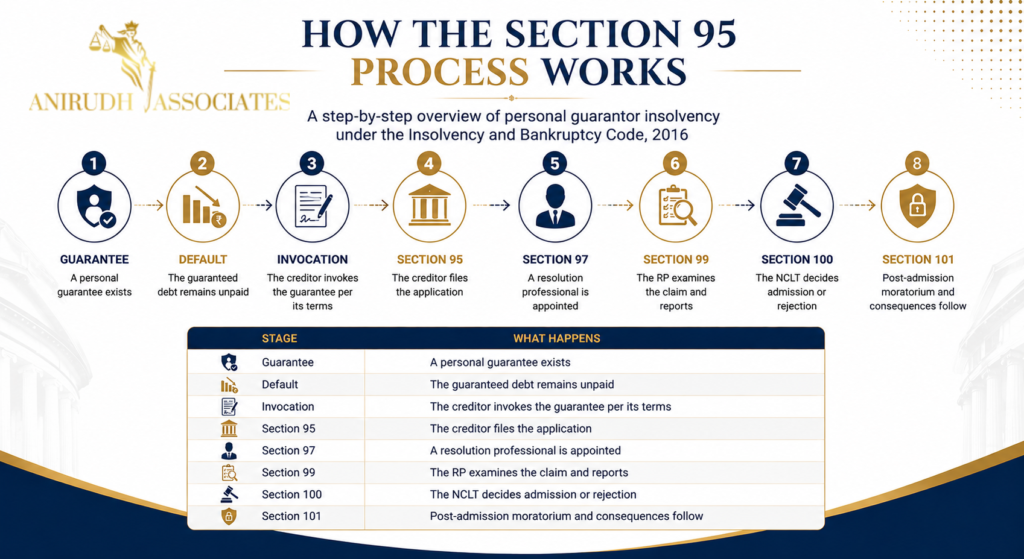
Take away the section numbers and the sequence is fairly intuitive:
How the Section 95 Process Works
- There’s a personal guarantee in place.
- The guaranteed debt goes into default.
- The creditor invokes the guarantee, following its own terms.
- The creditor files under Section 95, either directly or through a resolution professional.
- A resolution professional gets appointed under Section 97.
- That RP reports back under Section 99, recommending admission or rejection.
- The NCLT decides under Sections 100 and 101.
- Once admitted, the consequences kick in, including the moratorium under Section 96.
| Stage | What Happens |
| Guarantee | A personal guarantee exists |
| Default | The guaranteed debt remains unpaid |
| Invocation | The creditor invokes the guarantee per its terms |
| Section 95 | The creditor files the application |
| Section 97 | A resolution professional is appointed |
| Section 99 | The RP examines the claim and reports |
| Section 100 | The NCLT decides admission or rejection |
| Section 101 | Post-admission moratorium and consequences follow |
Step three looks like the boring one on paper. It isn’t. Invocation has quietly become the most fought-over issue in this whole area over the last couple of years, so it’s worth slowing down on.
Why Proper Invocation of the Guarantee Is Non-Negotiable
You’d think pointing to a signed deed and a defaulted loan would be enough to get a Section 95 application moving. It isn’t, and tribunals have been fairly unforgiving about this. Rule 3(1)(e) of the 2019 Rules defines a “guarantor” for these purposes as someone who hasn’t paid an invoked guarantee, and the NCLAT repeatedly reads that “and” literally as two distinct requirements. No invocation, no default in the legal sense, no application.
What’s interesting is how differently this has played out depending on what notice the creditor actually sent:
When a Notice Does and Doesn’t Count as Invocation
- In State Bank of India v. Deepak Kumar Singhania (NCLAT, February 2025), SBI tried arguing its statutory Form B demand notice was itself enough to count as invocation. The tribunal rejected this argument; Form B is merely a procedural step under Section 95, so the creditor must still invoke the guarantee separately according to its own contractual terms before issuing that notice.
- The NCLT’s Hyderabad Bench landed in the same place in a 2026 case involving Bank of Baroda and a guarantor of Vijay Home Appliances Ltd. Application dismissed, for the same reason: a Form B notice on its own doesn’t cut it.
- Then there’s Asha Basantilal Surana v. State Bank of India (NCLAT, May 2025), which pulled in the opposite direction. A three-member bench held that a notice under Section 13(2) of SARFAESI can amount to valid invocation, but only if it actually demands payment from the guarantor, in language that lines up with the guarantee agreement. The tribunal has relied on this reasoning in several subsequent cases, including one where mislabeling the guarantor as “director” in the notice did not matter because the underlying demand remained valid.
- And most recently, the NCLT’s Chandigarh Bench added a wrinkle worth knowing about: a SARFAESI notice by itself doesn’t prove invocation unless the actual deed of guarantee is on record for the tribunal to check the notice against.
Put those together and the pattern is pretty clear, even if the individual outcomes cut both ways: form doesn’t decide the case, substance does. A notice counts as invocation if its wording genuinely matches what the guarantee requires and clearly asks the guarantor to pay, regardless of the underlying statute. Creditors who treat invocation as a routine box to tick end up suffering losses. Guarantors who assume every notice is automatically defective are finding that argument doesn’t always land either.
Section 95 Is Not Just “Section 7 for Individuals”
It’s a tempting shorthand, but it flattens a real distinction. Section 7 opens CIRP against a company as a legal entity. Section 95 runs against a natural person, under the separate framework Part III sets up for individuals and guarantors.
There’s a second reason this distinction matters. Lalit Kumar Jain established that the guarantor’s liability is legally separate from the company’s, a resolution plan for the company doesn’t wipe out the guarantor’s exposure. But “separate liability” isn’t the same as “the company’s status is irrelevant to how you actually run the case.” Cases on jurisdiction and thresholds, including Anita Goyal v. Vistra ITCL (India) Ltd. (NCLAT, February 2025), which confirmed the NCLT, not the DRT, is the right forum for these applications, show that the procedural mechanics can still hinge on where the corporate debtor’s case stands. The more accurate way to put it: the liability is independent, the procedure isn’t always.
Why This Route Has Become a Serious Tool
A few reasons this route has become a genuinely serious tool despite all that complexity:
- It’s a dedicated process. Instead of forcing standard civil recovery, this framework gives creditors a dedicated, specialized forum with streamlined timelines.
- It hits what promoters actually care about. Corporate insolvency works on the company’s asset pool and leaves the promoter disempowered, but not necessarily personally exposed beyond their shareholding. This route goes after the guarantor’s own home, investments, and reputation, in a visible, court-supervised process. Even a modest eventual recovery can be enough pressure to bring someone to the table.
- It stops the scramble. Once admitted, the moratorium freezes other proceedings against the guarantor, so value doesn’t leak away while everyone races to different courts.
Section 96 vs Section 14: Two Moratoriums, Not One
People researching this tend to assume the moratorium works the same way everywhere in the Code. It doesn’t. Section 14 establishes the CIRP moratorium to protect corporate assets during resolution plan formulation. Section 96 creates a distinct, narrower protection that attaches specifically to the guarantor upon filing a Section 95 application, targeting only the guarantor’s personal pending proceedings and assets rather than the company’s.
Worth getting right, because mixing the two up leads people to assume protections or restrictions that simply don’t apply at that stage.
Section 95: The Numbers at a Glance
| Metric | As of 31 March 2025 |
| Applications filed | 4,203 |
| Resolution professionals appointed | 1,832 |
| Applications admitted | 664 |
| Admitted cases closed | 196 |
| Approved repayment plans | 39 |
| Recovery under approved plans | ~₹129.40 crore |
| Recovery against relevant admitted claims | ~2.49% |
Source: IBBI Annual Report 2024–25.
For comparison, corporate CIRP under Section 7 has produced resolution plans totalling well over ₹3 lakh crore, with average realisations around 32% of admitted claims. So on pure recovery numbers, this isn’t close to a competing engine. It was never really built to be one.
The Real Story Might Be Leverage, Not Recovery
Sit with that gap for a second. Creditors have filed over 4,200 applications, yet only 39 have produced approved repayment plans, recovering roughly 2.49% of admitted claims. If you’re judging this purely as a recovery mechanism, the honest answer is that it isn’t working especially well yet.
But maybe that’s the wrong yardstick. A credible process that can freeze a guarantor’s other proceedings, put their personal assets on the table, and become part of the public record changes how that person negotiates, often long before the case ever reaches admission, let alone a repayment plan. Lots of filings paired with few completed recoveries is exactly what you’d expect from a tool whose real value is the pressure it applies, not the money it directly pulls in. A fair chunk of that pressure probably shows up as quiet settlements that never make it into these statistics at all. That doesn’t make Section 95 toothless, it makes it a different kind of tool than Section 7, and creditors treating it that way are probably reading it more accurately than the recovery percentage alone suggests.
Section 7 vs Section 95, Side by Side
| Consideration | Section 7 | Section 95 |
| Target | Corporate debtor | Personal guarantor |
| Objective | Corporate insolvency resolution | Personal-guarantor insolvency resolution |
| Asset pool | Corporate assets | Guarantor’s personal estate |
| Key process | CIRP | Personal-guarantor insolvency resolution process |
| Strategic value | Corporate recovery | Additional recovery, plus negotiation leverage |
| Relationship | Can proceed alongside guarantor action | Can proceed alongside corporate proceedings |
In practice, most creditors run these two as complementary rather than one-after-the-other. If the company’s own assets are thin, the guarantor route becomes the more meaningful play. If the company still has healthy assets but the promoter isn’t cooperating, running both at once tends to push things toward a settlement faster than either would alone.
What Recent NCLAT Decisions Are Actually Telling Us
Skip past the 2019–21 cases everyone already cites, and the last two years have mostly been about getting the mechanics right:
Invocation decides maintainability, full stop.
Deepak Kumar Singhania and the Hyderabad Bench’s Bank of Baroda ruling both say the same thing: a bare statutory notice, without real contractual invocation behind it, kills the application, no matter how large the default is. If you’re a creditor, check the invocation clause in the guarantee deed before you file, not after you’ve been dismissed.
But “technically defective notice” isn’t a magic defence either.
Asha Basantilal Surana and the cases that followed it show a SARFAESI notice, even one that gets a guarantor’s designation slightly wrong, can still count as valid invocation if the substance matches the guarantee’s terms. Guarantors banking on a form-over-substance argument shouldn’t assume it’ll work.
Settling the Forum Debate Regarding Jurisdiction
Anita Goyal confirmed the NCLT, not the DRT, is where these applications belong. Jurisdictional challenges built around sending guarantors to the DRT aren’t likely to go anywhere after this.
What You Should Keep in Mind
Although recovery numbers remain low, many applications stall near admission or during the resolution professional’s report stage instead of reaching a final outcome. Tracing an individual’s personal assets presents far greater challenges than auditing a corporate balance sheet, leading practitioners to note off the record that creditors leverage this process primarily for strategic pressure rather than standalone debt collection.
That hasn’t pushed regulators to abandon the framework, though. If anything, the response has been tighter scrutiny around invocation, closer coordination between resolution professionals, and continued reinforcement, through exactly the 2025 rulings covered above, that guarantors remain on the hook, provided the creditor actually gets the procedure right.
Before Filing Under Section 95: What Creditors Should Check
- Is there a genuinely valid, executed personal guarantee?
- Has it actually been invoked per its own terms, not just via a Form B notice?
- Has real default occurred, and is the claimed amount calculated correctly?
- Does the invocation notice clearly demand payment from the guarantor by name, in terms the deed would recognise?
- Are there limitation issues that need sorting before filing?
- Is the NCLT definitely the right forum given where the corporate debtor’s case stands?
- What does the guarantor’s realistic, recoverable asset position actually look like?
- What other proceedings against this guarantor are already running?
- Is this filing really about recovery, or is it about leverage, and does that change how you approach it?
If You’re a Personal Guarantor: What to Have Reviewed
If a creditor is coming after you under Section 95, these are the things worth getting a professional to actually look at, rather than assuming either way:
- The guarantee deed and its specific invocation requirements
- Whether the notice you received actually matches those requirements in substance, not just in form
- The default and debt calculation being relied on
- Any limitation issues
- Whether the procedure was followed properly at each stage
- The resolution professional’s report, once filed
- The grounds being used for admission
- Your own asset and liability picture, and what disclosure will involve
- Any other litigation already pending against you
- What a realistic settlement or repayment path actually looks like, given how these cases tend to play out
None of this is about dodging a real obligation. A properly invoked guarantee behind a genuine default is enforceable, and if anything the 2025–26 rulings make that clearer, not less. It’s a list of the specific points where creditors have gotten it wrong before, and where you’re entitled to have those points properly tested.
What This Means for You
If you’re a creditor
Section 95 gives you a real second line of enforcement, one that runs independently of the company’s own insolvency timeline and can put personal pressure on a promoter that the corporate case never could. But the last two years of case law make one thing obvious: get invocation right, on the guarantee’s own terms, or none of the rest matters.
If you’re a promoter or guarantor
The world has genuinely changed. A personal guarantee signed today is a real, enforceable commitment that outlives the company’s own resolution plan. At the same time, you’re entitled to insist that the creditor actually followed the guarantee’s own invocation process, not just fired off a generic statutory notice, before your personal insolvency gets put on the table.
Conclusion
Even the most powerful have lost strength. Section 95 of the Insolvency and Bankruptcy Code (IBC) has turned personal guarantees in India from mere administrative forms into effective legal tools. Currently, direct recovery rates are low and stand at 2.49%. However, the collection systems operate through an operational pressure framework. Assets are frozen and estates are exposed, and this usually leads to pre-admission settlements. Tribunals take procedural discipline very seriously. Creditors must follow the terms of the guarantee deed and cannot rely on Form B, which is a generic notice provided in the statute. Based on case law, which separates the corporate resolution plan from the liability of the guarantors, section 95 can be a very effective tool when combined with a corporate CIRP process.
Frequently Asked Questions
What is Section 95 of the IBC?
It lets a creditor apply to the NCLT to open an insolvency resolution process against a personal guarantor of a corporate debtor, once the guarantee’s been invoked and the debt is still unpaid.
Who can initiate proceedings under Section 95?
The guarantor’s creditor, usually a bank or financial institution, either directly or through a resolution professional.
Can a creditor still go after a personal guarantor once the company’s resolution plan is approved?
Yes. Lalit Kumar Jain settled this, approving the company’s plan doesn’t wipe out the guarantor’s separate liability.
What happens once a Section 95 application is filed?
A resolution professional gets appointed under Section 97, reports under Section 99, and the NCLT decides admission or rejection under Sections 100–101.
What’s the Section 96 moratorium?
A moratorium that kicks in for the guarantor once a Section 95 application is filed, different from the Section 14 moratorium that covers the company during CIRP.
Does a guarantor’s liability disappear once the company’s debt is resolved?
No. The two are legally separate, though the procedural route a creditor takes can still depend on where the company’s case stands.
Can a guarantor actually fight a Section 95 filing?
Yes, most commonly by arguing the guarantee was never properly invoked. That defence has succeeded in several 2025–26 rulings, though not automatically, and not in every case.
Does Section 95 actually work as a recovery tool?
The raw numbers say not really, around 2.49% of admitted claims recovered as of March 2025. What it seems to do more reliably is create leverage, pushing settlements that never show up in those recovery statistics at all.