
Here’s something nobody tells you at the start of a lawsuit: winning is not the hard part. Or rather, it’s hard, but it’s not the whole thing. Talk to anyone who’s actually had to enforce a decree in an Indian court, and they’ll tell you the judgment felt less like an ending and more like clearing the first big hurdle.
Then comes the part nobody warns you about. Objections. Applications to stall. Fights over who’s really sitting on the property. A judgment debtor who, somehow, manages to find a fresh procedural question every few months, none of which came up at trial. If you’ve sat through execution proceedings even once, this will sound painfully familiar.
That’s more or less the exact mess the Supreme Court was looking at in Rahul S. Shah v. Jinendra Kumar Gandhi & Ors., decided on April 22, 2021 (Civil Appeal Nos. 1659-1660 of 2021). And you should actually understand the changes brought to how execution courts are supposed to work, not just file them away.
What are Execution Proceedings under Order XXI CPC?
Order XXI of the Code of Civil Procedure, 1908 is what governs execution. Basically, it’s the machinery that’s supposed to turn a judgment sitting on paper into something real you actually get the property back, the money gets recovered, whatever the decree said should happen, happens.
Sounds simple enough. It almost never is. Judgment debtors, and sometimes people who bought or moved into the property after the fact, know exactly which levers to pull to slow things down. New suits. Appeals. Writ petitions. Filed years after the case was, technically, already over.
Key Supreme Court Guidelines in Rahul S. Shah v. Jinendra Kumar Gandhi
The Supreme Court didn’t mince words here. Execution, it said, is not a second trial. Once a decree is final, you don’t get to argue the same points again just because you’ve called them “execution objections” this time instead of trial arguments.
And it didn’t stop at saying this. It actually gave executing courts more room to act on it. Courts can now appoint a commissioner to go measure and identify the property in question, if there’s a real dispute about boundaries or who’s holding what. They can lean on the evidence that’s already been produced, rather than forcing everyone to relitigate the whole thing from scratch. And where someone is clearly gaming the system just to buy time, the court can hit them with exemplary costs.
There was also something a lot of lawyers had quietly wanted for a long time: an actual deadline. Because let’s be honest, in plenty of cases, “execution” has turned into its own ten-year-long court battle.
6-Month Timeframe for Disposing Execution Applications
This part is fairly concrete. An executing court is now expected to wrap up execution proceedings within six months of the petition being filed. Courts can extend that, but only if they write down the reasons for the delay no vague “adjourned to next date” without explanation.
The judgment also pushes courts to stop granting unnecessary adjournments, and it lays out how a judgment debtor should be brought into the case without turning it into another drawn-out affair. If execution genuinely needs help on the ground, the court can even ask the local police station to step in.
Taken together, this shifts the whole focus. It’s no longer just about whether a decree exists on paper it’s about whether the person who won actually gets what they were owed.
Handling Stalling Tactics & Objections in Execution Proceedings
None of this means a judgment debtor loses the right to object. Order XXI still allows for real questions to be raised about the identity of the property, say, or whether the decree can even be executed as it’s currently worded. What changed is how courts are meant to tell a genuine objection apart from a stalling tactic wearing an objection’s clothes.
Real disputes still get heard. Repeated applications that exist only to manufacture confusion and eat up time do not get the same benefit of the doubt anymore. Courts are expected to notice the difference quickly, instead of just listing the matter for yet another date.
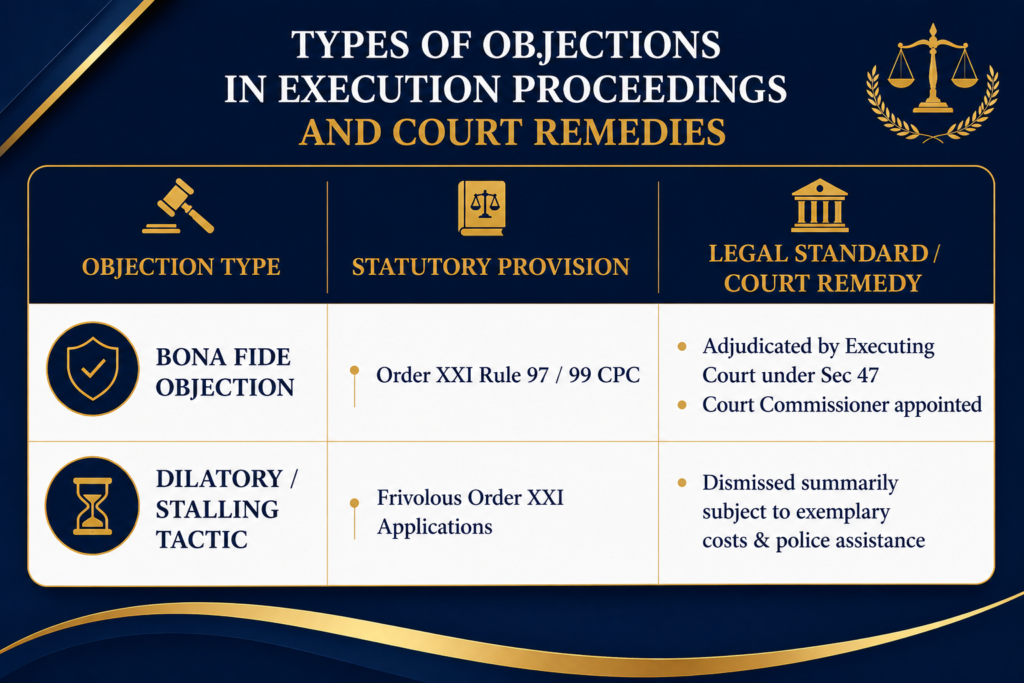
Type of Objections in Execution Proceedings and Court Remedies
| Objection Type | Statutory Provision | Legal Standard / Court Remedy |
| Bona Fide Objection | Order XXI Rule 97 / 99 CPC | Adjudicated by Executing Court under Sec 47; Court Commissioner appointed |
| Dilatory / Stalling Tactic | Frivolous Order XXI Applications | Dismissed summarily; subject to exemplary costs & police assistance |
Practical Remedies for Decree Holders and Judgment Debtors
If you’re the one holding the decree, the message is fairly plain. Getting your paperwork in order, moving quickly, and being ready to deal with procedure matters almost as much now as winning the case did in the first place. Courts have more freedom to move fast, and more reason to come down hard on anyone dragging their feet.
If you’re the judgment debtor, take this as a heads-up. Execution isn’t a chance to reargue the case you already lost. Whatever objection you’re raising needs to actually be about the execution, not the same fight, repackaged.
This matters a lot in property disputes, possession suits, and recovery matters in general, where a decree that just sits there unenforced for years can end up worth very little in practice. In these cases, how well you enforce a judgment can matter almost as much as how well you argued it.
Conclusion
Getting the right decree was never really the end goal. The real goal is that it turns into actual relief, and reasonably quickly. Rahul S. Shah makes that point pretty clearly: execution is there to carry out a right that’s already been decided, not to give anyone a second bite at it, and courts now have both the tools and the instruction to enforce exactly that.
If there’s one thing worth remembering from all this, it’s that winning the case and actually getting what you won are two different fights. Let the second one drag on too long, and it can quietly undo everything the first one achieved.
Stuck trying to enforce a decree, or defending against one? Our commercial litigation team can help you work through your options. Get in touch.
Frequently Asked Questions (FAQs)
What is the timeline for disposing of execution proceedings in India?
Under the mandatory directions issued by the Supreme Court in Rahul S. Shah v. Jinendra Kumar Gandhi, executing courts are required to dispose of execution applications within six months from the date of filing. Any extension beyond this six-month period requires the court to explicitly record written reasons for the delay.
Can an executing court go beyond the original decree?
No, it is a fundamental principle of civil law that an executing court cannot go beyond the decree. The executing court must enforce the decree as it is written and cannot re-examine the merits of the suit or re-adjudicate issues that were already decided during the original trial.
What remedies exist if a judgment debtor obstructs execution?
If a judgment debtor or third party obstructs execution, the court can appoint a Court Commissioner to identify property, seek local police assistance for enforcement, order civil imprisonment, or impose heavy compensatory costs for filing frivolous, mala fide objections under Order XXI CPC.
Which court has jurisdiction to execute a decree?
An execution petition must be filed either in the court that originally passed the decree or in the court to which the decree has been formally transferred for execution (e.g., where the judgment debtor resides or holds property) under Order XXI Rule 10 CPC.