
If you’ve bought a flat in a large Indian township project, you already know the corporate structure behind it is rarely simple. There’s usually a landowning company holding the title, a separate developer company doing the actual construction and marketing, and sometimes even a third entity collecting your payments. When the project stalls, that structure stops being a technical detail and starts becoming your problem.
Indian courts, including the NCLAT and the Supreme Court, have settled a question that long trapped homebuyers: allottees can file a single Section 7 insolvency application against two or more closely connected corporate entities in the same real estate project when facts show their joint involvement in its development and implementation.
The Trap Homebuyers Kept Falling Into
Builders typically structure real estate projects through a landowning SPV, a developer to construct and market the project, and occasionally a separate sales or marketing entity. When they delay or abandon a project, builders rely on a well-worn playbook of defences:
- No privity of contract. Builders argue that because you signed your agreement with the developer rather than the landowning company, you cannot proceed against the SPV.
- One petition, one company. Each entity is legally separate, so a single petition against more than one company is supposedly impermissible.
- Shrinking the denominator. Builders argue that courts should calculate the 100-allottee or 10% threshold under Section 7(1) against the entire township or a broader pool of buyers, pushing the petition below the statutory minimum.
Accepting these arguments would have forced homebuyers to litigate against multiple corporate entities separately, even when no single entity controlled the land, construction, or project obligations.
Can Homebuyers File a Joint CIRP Against Multiple Builder Companies?
Recent NCLAT and Supreme Court decisions have addressed some of the biggest hurdles homebuyers face when a stalled project involves more than one corporate entity. Four decisions are particularly relevant.
1. Satyabrata Mitra v. Earth Towne Infrastructure Pvt. Ltd.: How Is the Section 7 Threshold Calculated?
In Satyabrata Mitra v. Earth Towne Infrastructure Pvt. Ltd. (NCLAT, 2025), 146 homebuyers challenged the dismissal of their Section 7 petition.
The NCLT examined the statutory threshold by evaluating the broader pool of project allottees and the claims filed in the holding company’s CIRP.
The NCLAT found this approach legally incorrect and examined the corporate debtor’s own share of the project.
What the decision means for homebuyers:
- Homebuyers must measure the Section 7 threshold against the statutory requirements of the specific corporate debtor involved.
- Homebuyers should not automatically treat the entire township as the denominator when the corporate debtor has a specific share of the project.
- Filing a claim in the CIRP of a related company does not, by itself, make a homebuyer ineligible to proceed against another jointly connected entity.
- The corporate structure of the project therefore matters when calculating the threshold.
2. Manish Kumar v. Union of India: Which Date Matters for the Threshold?
In Manish Kumar v. Union of India (2021), the Supreme Court considered the validity and operation of the statutory threshold applicable to homebuyer insolvency applications.
Courts have subsequently relied upon this principle to determine the relevant eligibility date.
What this means for homebuyers:
- The filing date is critical when determining whether the statutory threshold has been satisfied.
- Subsequent developments do not automatically alter the factual status at the time of filing.
- Homebuyers should therefore carefully document their numbers and supporting records before filing.
3. Mist Avenue Pvt. Ltd. v. Nitin Batra: Can One Petition Cover Multiple Builder Companies?
In Mist Avenue Pvt. Ltd. v. Nitin Batra (NCLAT), three companies were involved in the development of the same real estate project through collaboration arrangements.
The NCLAT upheld the maintainability of a joint Section 7 application against the companies.
Why this decision matters:
- Multiple corporate entities can be proceeded against together in appropriate circumstances.
- The court can look at how the companies actually participated in the same project.
- Collaboration arrangements and the interdependence of the entities can be important evidence.
- Leaving one company outside the insolvency process may undermine an effective resolution where the project depends on the involvement of all the entities.
4. Satinder Singh Bhasin v. Col. Gautam Mullick: What Did the Supreme Court Say About Joint CIRP?
In Satinder Singh Bhasin v. Col. Gautam Mullick (2026), concerning the Grand Venezia project, the Supreme Court considered the relationship between two corporate entities involved in the project.
The Court upheld the maintainability of a joint insolvency process after examining the way the entities operated and dealt with the project and its allottees.
The Court considered factors including:
- Common directors and management links.
- Communications with allottees.
- Payment receipts and the flow of payments.
- The marketing arrangement between the companies.
- The extent to which the companies were intrinsically connected with the project.
- Whether bringing the entities together could help maximise asset realisation and facilitate an effective resolution.
Note: Separate incorporation does not necessarily end the inquiry. When multiple companies are intrinsically connected to the same project, courts examine the substance of their relationship to determine whether a joint insolvency process is maintainable.
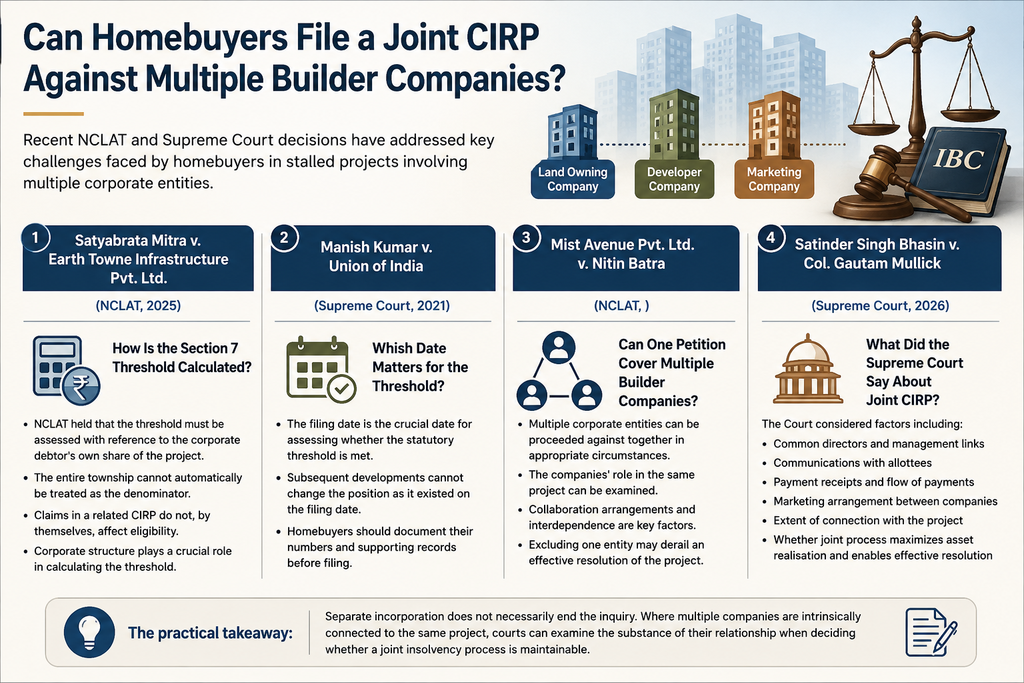
What Joint CIRP Actually Means?
It’s worth being precise here joint CIRP is not a statutory merger of two companies into one.
In practical terms, it means:
- A single Section 7 insolvency application can, in appropriate circumstances, be filed against two or more corporate debtors that are closely connected with the same real estate project.
- Each company remains legally distinct. The joint process is based on the nature of their involvement in the project and the need for an effective resolution.
- Courts look at substance over form including common management, collaboration or development agreements, shared project rights, payment arrangements, communications with allottees, and whether the project can realistically be resolved without bringing the connected entities into the insolvency process.
The Supreme Court’s 2026 decision makes this particularly clear: the fact that two companies are separate legal entities does not, by itself, prevent a joint insolvency petition where the evidence shows that they are intrinsically linked to the same project.
How to Know Whether a Joint CIRP May Apply to Your Project
A joint insolvency application will not apply simply because multiple companies are involved in a real estate project. The connection between them has to be real and supported by documents.
Look for signs such as:
- The land is owned by one company while another company developed the project.
- Two or more companies signed collaboration or development agreements for the same project.
- Your booking form, allotment letter, receipts, or emails mention different companies at different stages.
- The companies share directors or key management personnel.
- One company marketed or sold units on behalf of another.
- Payments were collected by one entity for obligations connected to another.
- The companies used interchangeable branding, communication channels, or representations while dealing with buyers.
- Resolving the project would be difficult if only one of the companies entered CIRP.
These factors do not automatically guarantee that a joint CIRP application will be admitted. However, they can help establish that the corporate entities were sufficiently connected to justify a consolidated insolvency process.
Documents Homebuyers Should Collect Before Considering a Joint CIRP
Before approaching the NCLT, homebuyers should build a clear record showing both the default and the relationship between the companies involved.
Useful documents may include:
| Document | Why It Matters |
| Builder-Buyer Agreement | Shows contractual obligations |
| Allotment Letter | Identifies the unit and allottee |
| Payment Receipts | Tracks where buyer money was paid |
| Bank Statements | Supports proof of payment |
| Collaboration or Development Agreements | Shows the relationship between project entities |
| RERA Records | Helps establish project and promoter details |
| MCA Records | Can reveal directors and corporate relationships |
| Emails and Letters | May show interchangeable dealings between companies |
| Possession Commitments | Helps establish default or delay |
| Other Allottees’ Details | Required for assessing the Section 7 threshold |
The corporate structure is often just as important as the default itself. A homebuyer group may have a valid claim but still face delays if it files against the wrong entity or fails to establish how multiple companies were connected to the project.
Documents Homebuyers Should Collect Before Considering a Joint CIRP
Before approaching the NCLT, homebuyers should build a clear record showing both the default and the relationship between the companies involved.
Useful documents may include:
| Document | Why It Matters |
| Builder-Buyer Agreement | Shows contractual obligations |
| Allotment Letter | Identifies the unit and allottee |
| Payment Receipts | Tracks where buyer money was paid |
| Bank Statements | Supports proof of payment |
| Collaboration or Development Agreements | Shows the relationship between project entities |
| RERA Records | Helps establish project and promoter details |
| MCA Records | Can reveal directors and corporate relationships |
| Emails and Letters | May show interchangeable dealings between companies |
| Possession Commitments | Helps establish default or delay |
| Other Allottees’ Details | Required for assessing the Section 7 threshold |
The corporate structure is often just as important as the default itself. A homebuyer group may have a valid claim but still face delays if it files against the wrong entity or fails to establish how multiple companies were connected to the project.
Why This Actually Matters?
It addresses three real problems for allottees.
First, it prevents corporate structuring from becoming an automatic shield. A developer cannot simply point to a separate landowning or marketing company and expect the insolvency process to ignore the way those entities actually operated together.
Second, it reduces the scope for artificial threshold calculations. The statutory threshold has to be applied to the relevant corporate debtor and project circumstances rather than manipulated by treating an unrelated or unnecessarily broad pool of allottees as the denominator.
Third, it makes project-level resolution more realistic. If one company holds the land while another developed, marketed, or collected money for the project, bringing only one entity into the process may leave the resolution professional without control over assets or rights that are essential to completing the project.
If You’re an Affected Homebuyer
- Map the corporate structure first. Identify the landowning SPV, developer, and any marketing or sales entity. Gather collaboration agreements, development agreements, allotment documents, and payment receipts showing how the entities were connected.
- Calculate the threshold carefully. Identify the relevant corporate debtor and its share of the project before calculating the statutory threshold. Do not automatically use the total number of buyers across the entire township.
- Consider a joint filing where the entities are genuinely linked. Common directors, collaboration agreements, shared project rights, common communications, payment arrangements, and other documentary evidence can help establish the connection between the entities.
- Preserve proof of default. Keep RERA correspondence, payment records, possession commitments, completion-certificate information, and communications showing that the developer failed to perform its obligations.
- Get advice early. Errors in the cause title, threshold calculation, or corporate mapping can delay insolvency proceedings and create avoidable disputes at the admission stage.
Conclusion
For homebuyers stuck in a stalled project involving multiple builder companies, identifying the right corporate structure can be just as important as proving the delay or default. Recent NCLAT and Supreme Court decisions show that corporate promoters cannot use separate legal entities to fragment a project and block an effective insolvency resolution.
When homebuyers face a stalled project involving a connected landowner, developer, and marketing entity, initiating a joint CIRP offers a more practical route to resolution. The key is to establish that connection clearly, calculate the Section 7 threshold correctly, and build the application around the actual structure of the project rather than the labels used by the companies involved.
Frequently Asked Questions
Can homebuyers file one insolvency petition against two builder companies?
Yes, in appropriate cases. The NCLAT and Supreme Court have recognised that a single Section 7 application can be maintained against multiple corporate debtors where they are closely connected with the same real estate project and their involvement is relevant to an effective resolution.
How is the 100-allottee threshold calculated?
Section 7(1) requires at least 100 allottees or 10% of the total number of allottees under the same real estate project, whichever is less. The calculation must be made with reference to the relevant corporate debtor and the circumstances of the case. The Supreme Court has also reaffirmed that the crucial date for determining the threshold is the filing date.
Does settling with allottees after filing reduce the count below the threshold?
A later development does not retrospectively change whether the statutory threshold was satisfied at the relevant filing stage. The Supreme Court has reaffirmed that the date of filing is the crucial date for determining the threshold.
Does a separate landowning company have to be included in the CIRP?
Not automatically. The question depends on the company’s actual involvement in the project and its legal and contractual relationship with the allottees and other project entities. Where the landowner and developer are closely connected and both are necessary for an effective resolution, courts have recognised that they may be proceeded against together.