
The intellectual property behind an early-stage company often comes into existence long before anyone stops to ask who legally owns it.
One founder writes the first version of the code on a personal laptop months before the company is incorporated. A friend designs the logo for a nominal fee. A development agency builds part of the platform based on a purchase order, invoices, and a long email chain.
At the time, everyone assumes the answer is obvious: the startup paid for it, built the business around it, and uses it every day. So, naturally, the company owns it. Then, years later, an investor’s lawyer or an acquirer’s diligence team asks a deceptively simple question:
Show us the chain of title to the platform.
That is where many startups run into trouble. Usually, there is no actual fight over ownership. The founders genuinely intended the company to own the IP. The problem is much simpler and potentially more expensive: the paperwork does not properly reflect that intention.
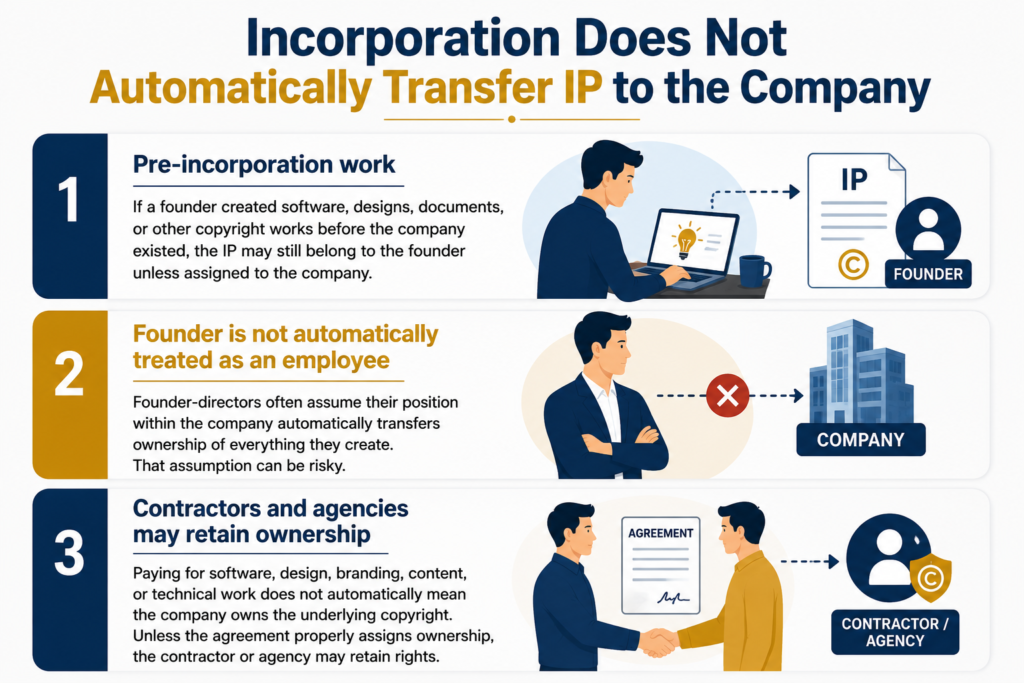
Incorporation Does Not Automatically Transfer IP to the Company
A common misconception among founders is that once a company is incorporated, all work connected with the startup automatically becomes company property.
That is not how ownership works. Under Section 17 of the Copyright Act, 1957, copyright generally starts with the author of the work. There are exceptions, including certain works created by employees in the course of employment under a contract of service.
For startups, this creates several potential gaps.
1. Pre-incorporation work may still belong to the founder
If a founder created software, designs, documents, or other copyright works before the company existed, the company could not have employed that founder at the time.
The work may therefore remain with the founder unless the founder later assigns it to the company.
This is particularly common with startups that begin informally. The founders build an MVP, test the product, speak to customers, and only incorporate once the business starts gaining traction. By then, some of the startup’s most important IP may already exist.
2. A founder is not automatically treated as an employee
Founder-directors often assume that their position within the company automatically transfers ownership of everything they create. That assumption can be risky.
Whether someone works under a contract of service depends on the actual legal relationship. A founder-director who does not have a properly documented employment relationship may not fit neatly within the employment exception that founders often rely on. The position needs to be examined based on the facts and documentation.
3. Contractors and agencies may retain ownership
Startups frequently outsource development, design, branding, content, or technical work.
Paying for the work does not automatically mean the company owns the underlying copyright.
India does not provide a broad rule that automatically transfers all commissioned software or creative work to the person paying for it. Unless the relevant agreement properly addresses ownership and assignment, the contractor or agency may retain rights in what it created.
That can become a serious issue when the software forms part of the company’s core product.
The Assignment Must Be in Writing and Must Cover the Right Things
Section 19(1) of the Copyright Act requires a copyright assignment to be in writing and signed by the assignor. That requirement immediately rules out many arrangements founders assume are sufficient. An email saying that the company owns the code may not operate as a properly structured assignment. A board resolution recording that IP has been transferred does not necessarily replace an assignment executed by the actual owner of that IP.
Similarly, an invoice containing broad language about transferring rights may not adequately address the statutory requirements for a copyright assignment. Section 19(2) also requires the assignment to identify the work and specify the rights assigned, the duration of the assignment, and the territorial extent. Those details matter more than many startups realise.
The Five-Year Default Under Section 19(5)
One of the biggest traps in founder IP documentation is the failure to specify the duration of the assignment. Under Section 19(5), where the period of assignment is not stated, the assignment is deemed to be for five years from the date of assignment. Section 19(6) creates another default: where the territorial extent is not specified, the assignment is presumed to extend only to India.
This can create unexpected problems during IP due diligence for a startup exit in India.
In Pine Labs Pvt. Ltd. v. Gemalto Terminals India Pvt. Ltd., the Delhi High Court considered an assignment of software copyright where the relevant agreement did not specify a duration. The five-year default under Section 19(5) became central to the dispute.
For a startup, the practical concern is obvious. Imagine a company incorporated seven years ago. At incorporation, a founder signs a short IP assignment stating that all existing code belongs to the company. The document identifies the code but does not mention duration. If Section 19(5) applies, the company may face an argument that the assignment operated only for five years.
That issue can suddenly become important during a funding round, acquisition, or other transaction where lawyers need to establish a clean IP chain of title for venture capital diligence. If the founder remains cooperative, the issue may be capable of remediation through a fresh or confirmatory assignment.
If the founder has left, is in dispute with the company, or cannot be located, the problem becomes significantly more complicated.
Section 19(4) Creates Another Issue Worth Checking
There is another provision that startups should not overlook. Section 19(4) provides that an assignment may lapse if the assignee does not exercise the assigned rights within one year, unless the assignment agreement provides otherwise. This can matter where IP was created for a product or project that remained dormant for an extended period.
For example, a company may commission software for a new product but delay the launch for more than a year. If the assignment documentation does not adequately address this issue, the company should review the arrangement carefully.
This is why an IP audit should look beyond a simple question of whether an assignment exists. The actual terms of the assignment matter.
Future IP Is Not Automatically Yours Either
Startup agreements often contain broad language covering intellectual property “created or to be created” in connection with the business. The commercial intention is understandable. The company wants to ensure that future code, designs, and other work created by founders belong to the business.
However, future works require careful drafting.
The first proviso to Section 18(1) recognises the assignment of future works, but the assignment takes effect only when the relevant work comes into existence. The distinction between a present assignment and a promise to assign later can become important during diligence. Consider the difference between language stating that a founder: “shall assign all future intellectual property to the company” and language structured to create a present contractual assignment that attaches to future works when they come into existence.
The first may be treated as an obligation to execute a future assignment. The second is designed to deal with ownership automatically when the work comes into existence. During a transaction, diligence counsel may scrutinise this distinction closely. If the original documentation only creates a promise to assign, the buyer or investor may require fresh confirmatory deeds from founders before closing. That can delay the transaction, particularly where former founders or contractors are difficult to locate.
New Modes of Exploitation Can Also Matter
IP documentation drafted during the early stages of a startup may not always anticipate how the business will develop. A company may begin with desktop software and later expand into mobile applications, cloud platforms, APIs, AI-based products, or other commercial models.
Copyright assignments should therefore be reviewed to ensure that the rights granted are broad enough for the company’s actual and intended use. The goal is not simply to have an assignment document. The goal is to ensure that the assignment covers the IP, rights, territories, duration, and commercial exploitation relevant to the business.
Consideration Should Not Be Treated as an Afterthought
Section 19(3) requires a copyright assignment to specify the royalty or other consideration payable to the author during the term of the assignment. A vague statement that rights are transferred “in consideration of mutual covenants” may invite questions depending on the structure of the arrangement. A more cautious approach is to clearly state the consideration for the assignment and maintain appropriate records.
Where a founder is genuinely employed by the company and creates work within the scope of that employment, salary and the employment relationship may be relevant to ownership and consideration. However, that analysis depends on properly documenting the employment relationship and the nature of the work. Again, the issue comes back to documentation.
Copyright Is Only One Part of the IP Chain
Software copyright often receives the most attention because it may form the core of the company’s valuation.
However, a proper IP due diligence exercise for a startup exit in India should review the entire IP portfolio.
This may include:
- Software and source code
- Patents and patent applications
- Trademarks
- Design registrations
- Domain names
- Social media handles
- Databases and technical documentation
- Brand assets
- Confidential information and trade secrets
Patent assignments also require careful attention to statutory requirements. Section 68 of the Patents Act, 1970 requires assignments and certain other interests relating to patents to be in writing and registered in accordance with the Act.
Trademark ownership and assignments should also be properly documented and, where appropriate, recorded with the Registrar. Domain names and social media accounts create another recurring problem. A startup may spend years building a brand only to discover that the main domain or social handle remains registered in a founder’s personal name. The company may control the account. That does not always mean the company legally owns it.
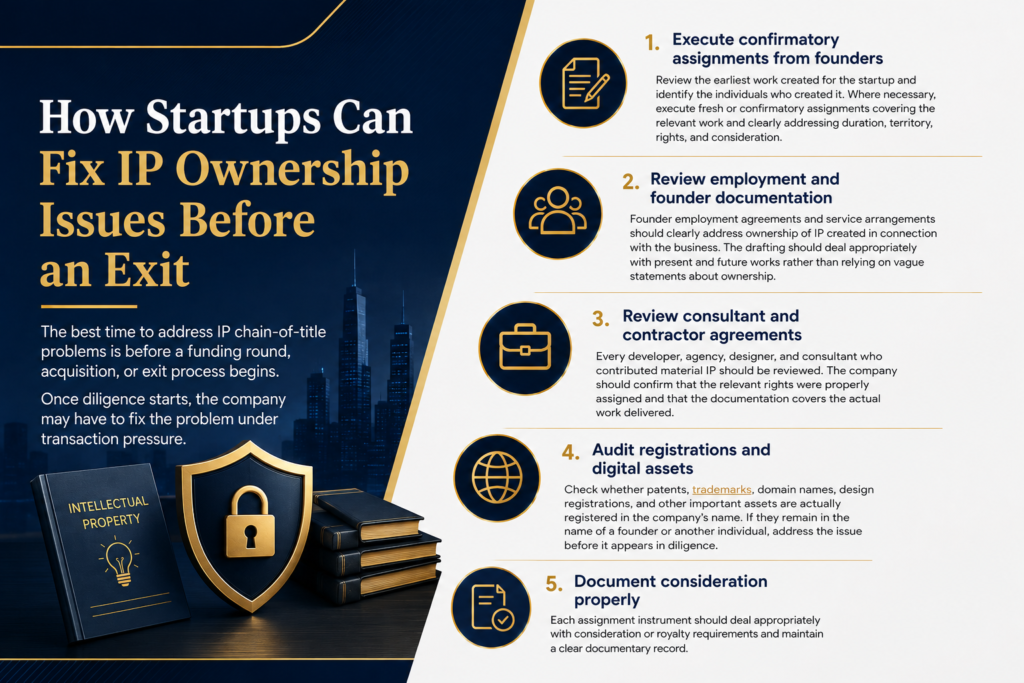
How Startups Can Fix IP Ownership Issues Before an Exit
The best time to address IP chain-of-title problems is before a funding round, acquisition, or exit process begins. Once diligence starts, the company may have to fix the problem under transaction pressure.
A practical remediation exercise can include the following.
1. Execute confirmatory assignments from founders
Review the earliest work created for the startup and identify the individuals who created it.
Where necessary, execute fresh or confirmatory assignments covering the relevant work and clearly addressing duration, territory, rights, and consideration.
2. Review employment and founder documentation
Founder employment agreements and service arrangements should clearly address ownership of IP created in connection with the business.
The drafting should deal appropriately with present and future works rather than relying on vague statements about ownership.
3. Review consultant and contractor agreements
Every developer, agency, designer, and consultant who contributed material IP should be reviewed.
The company should confirm that the relevant rights were properly assigned and that the documentation covers the actual work delivered.
4. Audit registrations and digital assets
Check whether patents, trademarks, domain names, design registrations, and other important assets are actually registered in the company’s name.
If they remain in the name of a founder or another individual, address the issue before it appears in diligence.
5. Document consideration properly
Each assignment instrument should deal appropriately with consideration or royalty requirements and maintain a clear documentary record.
Why This Matters During Funding and Exit Diligence
Institutional investors and acquirers do not review IP ownership simply to create another checklist. They want to know whether the company actually owns the assets it claims to be selling or receiving investment for.
A weak founder IP assignment for a startup in India can lead to several consequences during a transaction:
- Additional diligence questions
- Confirmatory assignment requirements
- Conditions precedent to closing
- Specific indemnities
- Founder-level liability or holdbacks
- Delays to the transaction timeline
- Reduced negotiating leverage
The commercial impact depends on the importance of the IP and the seriousness of the defect. A missing assignment relating to a minor marketing design may be easy to resolve. A missing or defective assignment relating to the company’s entire source code is a different matter.
Founder IP Assignment and Diligence Checklist
Before beginning a funding round, acquisition, or other transaction process, a startup can use the following as an initial internal review checklist:
- Identify IP created before the company was incorporated.
- Confirm that founders have assigned relevant pre-incorporation IP to the company.
- Review whether copyright assignments are in writing and properly executed.
- Confirm that relevant assignments address duration and territorial extent.
- Review documentation relating to future works and future intellectual property.
- Identify developers, consultants, agencies, and other third parties who contributed material IP.
- Confirm that contractor and consultant documentation addresses ownership and assignment.
- Review ownership of patents, trademarks, design registrations, domain names, and other digital assets.
- Check whether important accounts or registrations remain in the personal name of a founder or former employee.
- Identify documentation gaps before the formal diligence process begins.
Conclusion
Most startup IP ownership problems do not begin with a dispute.
They begin with assumptions. A founder assumes that incorporating the company transferred the code. A company assumes that paying a contractor transferred the software. Everyone assumes that a one-page assignment signed years ago will work indefinitely. Those assumptions are often tested only when an investor, buyer, or diligence lawyer asks for proof.
By that stage, the startup may have limited time to reconstruct years of development history and obtain signatures from former founders, employees, contractors, and agencies. That is why IP chain of title deserves attention long before the term sheet arrives. A proper review of founder assignments, employee agreements, consultant arrangements, and registered IP can help identify gaps while they are still relatively easy to fix. When the transaction is already live, the same problem can become a condition precedent, an indemnity issue, or a negotiating point that affects the founders directly.
If your startup is preparing for a funding round, acquisition, or exit, reviewing the IP chain of title early can prevent a documentation issue from becoming a transaction problem.
Frequently Asked Questions
Does a startup automatically own IP created by its founders?
Startup ownership depends on how and when the intellectual property was created, the relationship between the creator and the company, and the relevant contractual and statutory framework. Pre-incorporation work and work created outside an applicable employment relationship may require separate documentation.
Does incorporating a company automatically transfer IP created before incorporation?
Incorporation does not necessarily transfer intellectual property created before the company existed. Startups should review pre-incorporation work and the documentation relating to its assignment to the company.
Does paying a contractor mean that the startup owns the code?
Payment for development work does not necessarily establish ownership of the underlying intellectual property. The relevant agreement and applicable legal framework should be reviewed to determine whether the necessary rights were properly transferred or assigned.
What happens if a copyright assignment does not specify its duration?
The duration of a copyright assignment can have legal consequences under Section 19(5) of the Copyright Act, 1957. Documentation should therefore be reviewed carefully to determine how the statutory provisions apply to the particular assignment.
Can a founder assign future intellectual property to a startup?
The Copyright Act recognises assignments relating to future works, subject to the applicable statutory framework. The drafting of the relevant agreement is important because the distinction between an assignment structure and an obligation to assign may become relevant.
What should be reviewed during startup IP due diligence?
A review may include founder assignments, employee agreements, consultant and contractor agreements, software and source code ownership, patents, trademarks, design registrations, domain names, digital accounts, technical documentation, and other assets relevant to the company’s business.
We advise founders, companies, and investors on IP assignment structuring, diligence remediation, and transaction documentation in Indian venture and private equity deals. If you’re preparing for a funding round or exit, or have inherited assignment documents you’re not confident about, you can contact Anirudh Associates for a review.