
Imagine spending a significant amount of time coming up with exquisite packaging for your start-up products, only to have another company release a similar product. While they might not have stolen your logo or brand name, you still have to worry about how the customers will distinguish between the two products. That is why trade dress protection plays such a crucial role in the growth of a start-up.
Indian law does not recognize the category of trademark registration known as “trade dress.” Nevertheless, particular aspects or components of trade dress can sometimes be registered as trademarks. If distinctive and capable of distinguishing the goods or services of one trader from those of another, and if meeting the other criteria set out in the Trade Marks Act 1999, they may be eligible for registration as such. Design and copyright protection of trade dress may also be relevant, depending on its nature. It may also be possible to protect an unregistered trade dress by relying on the common law of passing off.
What Is Trade Dress, and How to Protect it in India?
Trade dress generally refers to the overall look or image that makes a particular product, service or business recognizable to the consumer. Depending on the circumstances, it may consist of packaging, design or shape of a product, combination of colors, labels, graphics, typography, interior of a store, signs, uniforms and many other visual elements
Although Indian law does not provide for separate registration of trade dress, its various elements may qualify for protection as trademarks under the Trademarks Act, 1999 or pass off, depending on the circumstances. In particular, the Trademarks Act, 1999 allows for the protection of “shape of goods or its packaging” or “combination of colors” as trademarks, if they meet the criteria for registration provided in the Act. A common law action of passing off may protect an unregistered trade dress in an appropriate case, provided that the plaintiff proves the necessary elements of goodwill, misrepresentation and damage.
For startups, trade dress may well be their most valuable asset as it often plays a critical role in the recognition process of their products by customers. Thus, the creation of a particular image of a product through its overall presentation, color scheme, design of stores selling the goods, and other elements is essential.
Trade Dress vs Trademark, Design and Copyright: What Should a Startup Protect?
| Brand asset | Potential protection |
| Brand name | Trademark |
| Logo | Trademark / copyright, depending on circumstances |
| Packaging artwork | Trademark / copyright / potentially design |
| Product shape | Trademark / design, depending on circumstances |
| Colour combination | Trademark, subject to statutory requirements |
| Original illustrations | Copyright |
| Overall distinctive get-up | Trademark / passing off, depending on circumstances |
| Functional product features | May face limitations under trademark law |
What Counts as a Trade Dress? Elements Every Startup Should Track
Trade dress is rarely limited to start‑up for a particular detail. Quite often, there is more than one component contributing to the impression of a distinctive “look” or “get‑up.” Each of these components will have to be considered separately in terms of its functionality, distinctiveness, and status as a generic, descriptive, or inherently capable of identification.
- Package design (unique bottle shapes, cosmetic boxes, luxury cartons)
- Predominant colours
- Label design and font
- Patterns or prints
- Store interiors (cafes, salons, flagship retail outlets)
- Uniforms and signs
- Menus or other selling tools
The more elements are cohesive, the better it is for the trademark portfolio since it will be easier to prove that the market associates certain goods with a particular company.
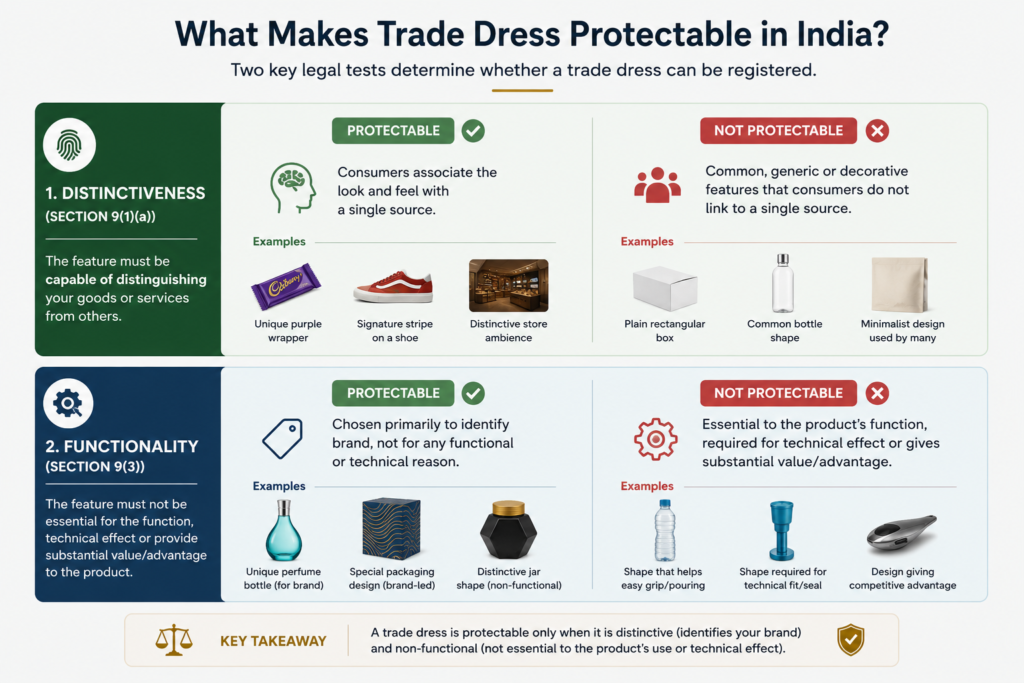
What Makes Trade Dress Protectable in India?
Not every design is eligible for protection.
The distinctiveness bar (section 9(1)(a))
A fundamental question is whether the said feature is capable of distinguishing the goods or services of one proprietor from others. The statutory test for distinctiveness can be gathered from section 9(1)(a) of the Trade Marks Act, 1999.
Thus, for start-ups, it indicates that a mere fancy mark may not always be sufficient to constitute a trademark. This is because for a feature to amount to a trademark it must possess the ability to indicate the source of the goods or services and be associated by the consumers with a particular enterprise.
The functionality bar (section 9(3))
Under the Act, you may not register shapes of goods and shapes of packaging for goods “as trade marks if they consist in the shape of the goods or of the packaging thereof resulting from the nature of the goods themselves, or necessary for the purpose of obtaining a technical effect, or which give substantial value or significant advantages to the goods”. This means that people will not register a shape that they choose for its functionality (for example, a particular shape of a bottle facilitates pouring of the liquid and therefore they choose it for this purpose). However, you may well register a particular shape or design chosen for the purpose of identifying the brand.
Inherent vs Acquired Distinctiveness: Why Timing Matters
A basic question that needs answering is whether a claimed feature is capable of distinguishing the goods or services of one proprietor from those of another. Section 9(1) (a) of the Trade Marks Act, 1999 discusses the distinctiveness of a trademark.
For example, in the case of a newly created start up, unique packaging would be essential, as extensive marketing and use may lead to an acquired distinctiveness, and thus a potential trademark.
Why Registering a Single Colour as a Trademark Can Be Difficult in India?
A single colour may prove particularly challenging to trademark since the applicant will have to demonstrate that it serves as a source identifier and not simply as an ornamental characteristic. As such, the manner in which a single colour is used, the class of goods/services and the distinctiveness of the colour may prove to be decisive factors. The colour combination, or colours used in a distinctive arrangement that have been used in a manner that renders them capable of qualifying as a badge of origin may, depending on the circumstances, be successful in securing trademark registration.
Whether a particular colour or a combination of colours will qualify for trademark registration ultimately depends on the ability of the trademark applicant to demonstrate that a given colour or colour combination can serve as a source identifier and meet all of the requirements associated with trademark protection.
5 Steps to Build a Trade Dress Portfolio Early
- Audit all repeated visual elements and separate brand-defining elements from those that are merely functional as you may need to defend them in passing off proceedings or in relation to registration of design rights.
- File early for device marks, colour combination and non-functional shape marks in classes of goods and services as soon as possible once you identify brand-defining features.
- Standardise usage of colour palettes, packaging formats and layout across all products and markets to enable acquired distinctiveness.
- Lock down IP ownership in vendor contracts to see the evidence section below.
- Get a trademark opinion before major spending ahead of major investment in brand development such as a new packaging design, rolling out new retail formats or product lines, and obtain trademark clearance advice on distinctive features and an analysis as to what you may register and what you may only protect by passing off.
Evidence That Protects You Later
Evidence is as vital as registration. It is essential that startups keep records of the following:
- Invoices and pictures with dates
- Samples of the packaging or design and its electronic files
- Proof of marketing efforts and announcements about the launch
- The screen shots of the marketplace with the first appearance of the product/brand
Conclusion
Trade dress is often the most valuable but neglected of a young start-up’s intellectual property (IP). Fortunately, as explained in this paper, Indian law provides several ways to protect it by using trademarks, design and copyright law, as well as passing off. In order to fully benefit from the potential of trade dress, start-ups should identify and formalize it at an early stage and take all possible IP-related measures to register and defend it.
Frequently Asked Questions
Is trade dress a legally recognised term in India?
Not exactly. It falls under the broader IP protection of marks which is covered under the Trade Marks Act, 1999 (both shapes, packaging and colour). Further, passing off is also a common law remedy which can also be used to sue for infringement of trade dress in India.
Can I register a single colour as my trademark?
Not really, as far as India is concerned. In Indian jurisprudence, cases are decided on a case to case basis but it has been held that a combination of colours or the use of a particular colour in a particular layout is necessary for registration. Using a single colour will not be sufficient.
What is the difference between infringement and passing off?
Infringement is a tort covered under Section 29 of the Trade Marks Act, 1999 while passing it off is a common law. Infringement is a matter between registered trade marks, while passing off occurs mainly between unregistered trade marks.
Further, infringement requires proof of the registration of the trade mark, while a passing off action requires proof of goodwill, misrepresentation and damage. Therefore, the difference is that infringement is a violation of the law against registered trademarks, while passing off is a tort against unregistered trademarks that have developed goodwill.
When should a startup begin documenting their trade dress?
Right from the beginning. If they can prove acquired distinctiveness, it would ease the evidentiary requirements in terms of proof of use. Documenting photographs of the use of the trade dress, bills, et cetera is extremely important.