
If you have booked a flat with a developer running multiple projects across cities, you may have felt a specific kind of dread: what happens to your flat if a completely different project pulls the company into insolvency proceedings?
That is not a hypothetical anymore; it is one of the most actively litigated questions in Indian real estate law today. Recent NCLAT rulings, including the 2026 decisions in Surender Singh (Vatika Limited) v. IDBI Trusteeship and Navin M. Raheja v. Vipul Jain & Ors., have brought real clarity to it.
Can One Project Default Freeze Your Developer?
Under the Insolvency and Bankruptcy Code, a single default even one tied to a lender’s claim on just one project can trigger insolvency proceedings against the entire corporate debtor. For a real estate group running dozens of projects across several states, that’s a genuine crisis for buyers who have nothing to do with the project that actually defaulted.
The moment the tribunal admits an insolvency application, a moratorium freezes the entire company and an Interim Resolution Professional takes over management. In theory, this sweeps every project under that developer, even fully constructed, fully paid, or near-handover developments, into the same process as the single distressed project that triggered the default.
This is exactly what played out in the Umang Realtech case (2020), where allottees who’d already paid up and were on the verge of getting possession suddenly found their flats caught in a company-wide insolvency process triggered by a handful of defaulting buyers. Years later, in Vatika, a debenture trustee’s claim tied to funding for a single plot of land threatened to pull 58 projects and roughly ₹18,000 crore worth of assets across Haryana and the NCR into insolvency even though the security itself related to just one project. In Raheja Developers, allottees of one specific project’s proceedings technically extended CIRP to the whole company, threatening to sweep in unrelated projects and their buyers.
The core problem lies in a fundamental structural mismatch, the IBC treats a developer as a single corporate entity, whereas real estate groups actually manage multiple financially independent projects under one umbrella. Treating the whole company as a single insolvency unit ends up punishing innocent buyers of solvent, on-track projects for a default that has nothing to do with them.
What Is Project-Wise Insolvency Resolution?
Carving out also called project-wise resolution is the practice of confining the effects of insolvency (the moratorium, the resolution professional’s control, the asset freeze) to the specific project connected to the actual default, rather than letting it spill across the developer’s entire corporate structure.
This isn’t just a policy preference anymore it has real regulatory and judicial backing:
- On the regulatory side, amendments to the CIRP Regulations already anticipate this: separate bank accounts required for each real estate project (Regulation 4D), resolution plans invited project-by-project (Regulation 36A), possession handed over project-wise (Regulation 4E), and RERA’s involvement built in (Regulation 18(4)).
- On the judicial side, NCLAT held in Umang Realtech that where allottees or lenders of one project trigger insolvency, the process must stay confined to that project and cannot engulf others in different cities, under separate approvals, with separate land and stakeholders. That reasoning carried through Gagan Tandon v. IL&FS Financial Services and applied again in 2026: in Vatika, NCLAT modified the admission order to confine proceedings strictly to Project Aspirations in Sector 88B, Gurgaon, because the parties created the debenture security over that specific project; in Raheja Developers, NCLAT confined proceedings to “Raheja Shilas (Low Rise)” alone, leaving buyers of other projects free to pursue independent proceedings.
Worth being precise here: the IBC doesn’t technically recognise “project-wise insolvency” as its own legal category; insolvency still attaches to the corporate debtor as a whole. What tribunals actually permit is project-wise resolution: creditors trigger the process against the company, but tribunals ring-fence practical control and asset recovery to the specific project connected with the default.
How Project-Wise Resolution Protects Buyers?
- It protects buyers who did nothing wrong. A moratorium triggered by an entirely different project’s default does not affect allottees in solvent, unrelated, or near-complete projects.
- It stops disproportionate value grabs. A lender or buyer group with claims over one project can’t use insolvency as leverage to seize control of assets worth many times the amount actually in default a risk the Vatika judgment flagged explicitly.
- It preserves construction momentum. Projects nearing completion with occupation certificates in progress and fit-outs underway, as in Raheja Developers, can keep moving instead of staying frozen pending a company-wide resolution plan.
- It matches the Supreme Court’s own view of what the IBC is for. The 2025 ruling in Mansi Brar Fernandes v. Shubha Sharma held that in real estate, the IBC is a forum of last resort meant to secure completion of viable projects not a debt-recovery tool and that resolution should generally proceed project-wise unless there’s a real reason not to.
- It doesn’t let defaulters off the hook. Carving out isn’t a blanket exemption the specific defaulting project still goes through the process, so creditors keep their genuine remedies.
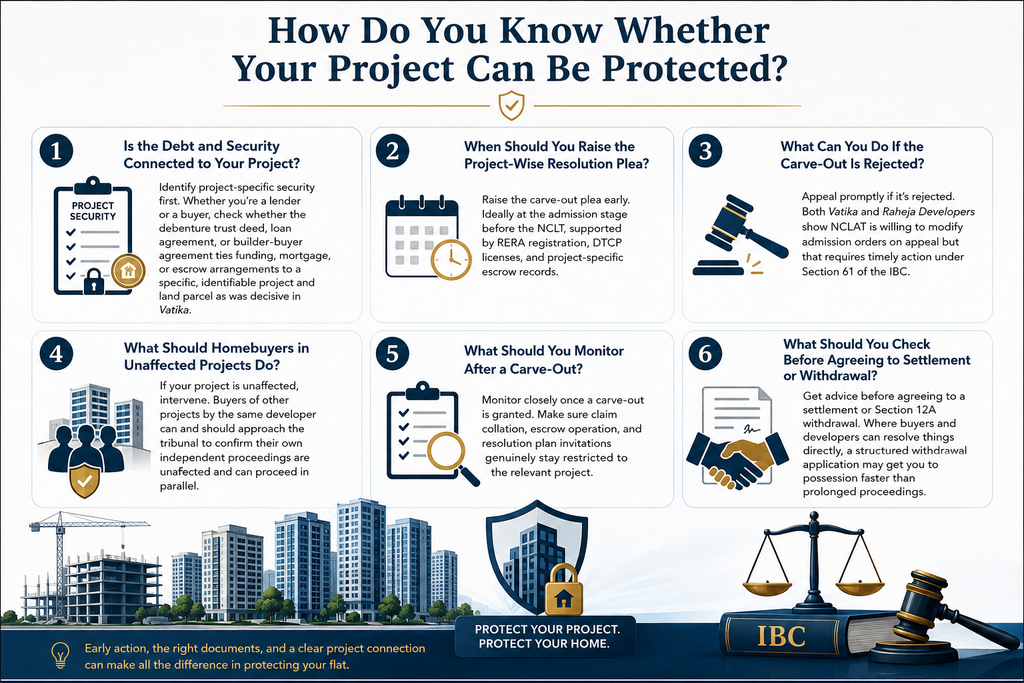
How Do You Know Whether Your Project Can Be Protected?
1. Is the Debt and Security Connected to Your Project?
Identify project-specific security first. Whether you’re a lender or a buyer, check whether the debenture trust deed, loan agreement, or builder-buyer agreement ties funding, mortgage, or escrow arrangements to a specific, identifiable project and land parcel as was decisive in Vatika.
2. When Should You Raise the Project-Wise Resolution Plea?
Raise the carve-out plea early. Ideally at the admission stage before the NCLT, supported by RERA registration, DTCP licenses, and project-specific escrow records.
3. What Can You Do If the Carve-Out Is Rejected?
Appeal promptly if it’s rejected. Both Vatika and Raheja Developers show NCLAT is willing to modify admission orders on appeal but that requires timely action under Section 61 of the IBC.
4. What Should Homebuyers in Unaffected Projects Do?
If your project is unaffected, intervene. Buyers of other projects by the same developer can and should approach the tribunal to confirm their own independent proceedings are unaffected and can proceed in parallel.
5. What Should You Monitor After a Carve-Out?
Monitor closely once a carve-out is granted. Make sure claim collation, escrow operation, and resolution plan invitations genuinely stay restricted to the relevant project.
6. What Should You Check Before Agreeing to Settlement or Withdrawal?
Get advice before agreeing to a settlement or Section 12A withdrawal. Where buyers and developers can resolve things directly, a structured withdrawal application may get you to possession faster than prolonged proceedings.
What Do the 2026 NCLAT Decisions Mean for Homebuyers?
Surender Singh (Vatika Limited) v. IDBI Trusteeship
In Surender Singh (Vatika Limited) v. IDBI Trusteeship, the NCLAT modified the admission order to confine the CIRP to “Project Aspirations” in Sector 88B, Gurgaon, where the relevant security was connected with that project.
The decision is particularly relevant where a developer has multiple projects, but the creditor’s debt and security can be traced to one specific project.
Navin M. Raheja v. Vipul Jain & Ors.
In Navin M. Raheja v. Vipul Jain & Ors., the issue similarly concerned whether CIRP initiated by allottees of a particular project should be confined to that project or extend across the developer’s other projects. NCLAT’s 20 March 2026 proceedings are recorded by IBBI, and contemporary reporting describes the Tribunal as confining the CIRP to the concerned project.
These decisions make the project-specific question particularly important for homebuyers dealing with developers that operate multiple projects through the same corporate entity.
Why This Matters: Your Flat Should Not Become Collateral Damage
A developer may operate dozens of projects, but that does not mean every homebuyer should bear the consequences of a default in one of them.
The strongest protection lies in proving the connection or lack of connection between your project and the debt that triggered insolvency. If your project’s land, approvals, finances, escrow arrangements and stakeholders are genuinely separate, you may have a strong basis to argue that it should not be unnecessarily pulled into proceedings involving another project.
Conclusion
Real estate insolvency law in India is moving fast, and project-wise carving out is now a well-established doctrine, not a fringe argument. Whether you’re protecting a flat, a lender’s security, or a developer’s ability to actually finish construction, knowing how and when to invoke this principle can be the difference between years of litigation and a swift, project-specific resolution.
The key is not simply whether your developer has entered insolvency.
The key is whether your project is actually connected to the debt, security and default that triggered the proceedings.
Frequently Asked Questions
Can insolvency in one project affect another project of the same developer?
Not necessarily. Recent NCLAT decisions show that, in appropriate cases, CIRP can be confined to the project connected with the relevant debt, security and stakeholders rather than automatically affecting unrelated projects.
What is project-wise insolvency in real estate?
Project-wise insolvency is commonly used to describe the confinement of insolvency proceedings or resolution activity to the real-estate project connected with the underlying default. Strictly speaking, the IBC does not create “project-wise insolvency” as a separate statutory category.
What is a project carve-out?
A project carve-out means restricting the practical effect of insolvency proceedings to the project connected with the relevant debt and security, rather than allowing unrelated projects of the same developer to be unnecessarily affected.
Does project-wise resolution protect homebuyers in other projects?
It can. The purpose is to protect homebuyers and other stakeholders in projects that are financially and legally distinct from the project responsible for the default, where the facts justify separate treatment.
What did NCLAT decide in the Vatika case?
In Surender Singh v. IDBI Trusteeship Services Ltd., NCLAT upheld the initiation of CIRP against Vatika Limited but modified the order to confine the process to “Project Aspirations” in Sector 88B, Gurgaon.
What did NCLAT decide in the Raheja Developers case?
In Navin M. Raheja v. Vipul Jain & Ors., NCLAT dealt with the question of whether CIRP concerning a particular project should affect the developer’s other projects. The Tribunal confined the process to the concerned project rather than allowing it to automatically extend across unrelated projects.
What documents should a homebuyer check if another project enters insolvency?
Check the insolvency admission order, your builder-buyer agreement, RERA registration, project approvals, land details and available information concerning project-specific financing, security and escrow arrangements.
Can homebuyers of an unaffected project approach the tribunal?
Depending on the circumstances, buyers of an unaffected project may approach the appropriate tribunal to place their project’s independent interests and documents on record and seek appropriate directions.
Does a project carve-out cancel the creditor’s debt?
No. A carve-out concerns the scope and operation of the insolvency process. It does not automatically extinguish a valid debt or prevent a creditor from pursuing remedies available under law.
Is project-wise resolution automatic when a developer has multiple projects?
No. The existence of multiple projects alone does not guarantee a carve-out. The nature of the default, security, land, approvals, finances and stakeholders can all be relevant.
What should a homebuyer do if another project of the developer enters insolvency?
Identify the creditor and the default, examine the security documents, check your project’s RERA and approval records, establish whether your project is financially and legally separate, and seek legal advice on the appropriate steps.