
No. Once a sale deed is validly registered and the entire sale consideration has been paid, the seller cannot unilaterally cancel it by simply executing and registering a “cancellation deed. Indian courts have repeatedly held that such unilateral cancellation deeds are void and can be ignored altogether. If you are a buyer facing this situation, the law is firmly on your side but you do need to act correctly to protect your title.
What the Supreme Court Has Said
The leading authority on this point is Thota Ganga Laxmi v. Government of Andhra Pradesh, where the Supreme Court held that if a seller wants a registered sale deed cancelled, they must file a civil suit for cancellation, or persuade the buyer to sell the property back to them.
The Court was direct: a cancellation deed executed and registered unilaterally by the seller is “wholly void and non est” and can be ignored altogether describing the practice as “unheard of in law.”
This was reinforced in Satya Pal Anand v. State of M.P. (2016) 10 SCC 767, where the Supreme Court, while agreeing that a seller cannot unilaterally cancel a registered sale deed, clarified that irregularities in the registration process where fraud is not established do not by themselves void a valid transaction.
The Court held that the Registration Act, 1908 provides a mechanism to challenge documents through civil courts, not through unilateral cancellation.
Why the Law Works This Way
Once a registered sale deed is executed for full consideration, title to the property has already passed from the seller to the buyer.
A contract of sale, once executed, cannot be unilaterally rescinded this flows from Section 62 of the Indian Contract Act, 1872, which requires bilateral consent to rescind, alter or novate a contract.
A cancellation deed signed only by the seller does not create, extinguish, or transfer any right, title or interest in the property, because the seller no longer has any interest left to act upon.
The Madras High Court’s Full Bench in Latif Estate Line India Ltd. v. Hadeeja Ammal examined this at length and found no provision in either the Transfer of Property Act or the Registration Act permitting a seller to unilaterally cancel a sale deed.
The Court went further, holding that allowing such cancellations encourages fraud and is against public policy.
What About the Sub-Registrar’s Role?
A related question buyers often ask: can the Sub-Registrar simply refuse to act on, or independently cancel, a registered sale deed?
The answer is no. Courts across jurisdictions including the Gauhati High Court, which held that a registering authority becomes functus officio (without further power to act) once a document is registered have consistently held that the Registration Act, 1908 does not confer any power on a Registrar to cancel a document after it is registered.
The Jharkhand High Court has similarly held that a registered deed cannot be cancelled by the Registrar without a civil court’s declaration that it is vitiated by fraud.
In several states, cancellation of a registered sale deed additionally requires bilateral consent under provisions like Section 32-A of the Registration Act, 1908 including biometric identification of all original parties precisely to prevent one-sided cancellations from being registered at all.
What If the Seller Has Already Registered a Cancellation Deed?
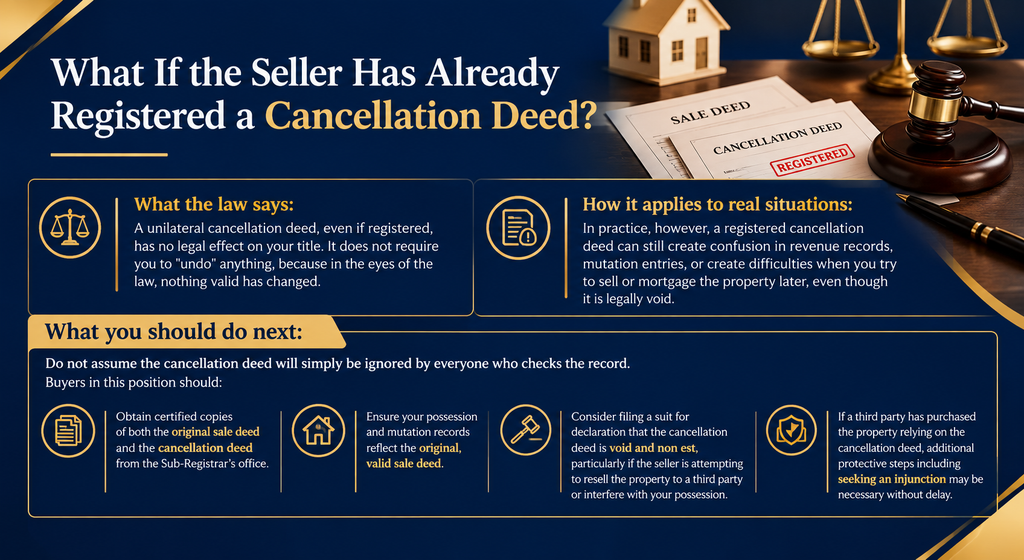
What the law says: A unilateral cancellation deed, even if registered, has no legal effect on your title. It does not require you to “undo” anything, because in the eyes of the law, nothing valid has changed.
How it applies to real situations: In practice, however, a registered cancellation deed can still create confusion in revenue records, mutation entries, or create difficulties when you try to sell or mortgage the property later, even though it is legally void.
What you should do next: Do not assume the cancellation deed will simply be ignored by everyone who checks the record. Buyers in this position should:
- Obtain certified copies of both the original sale deed and the cancellation deed from the Sub-Registrar’s office.
- Ensure your possession and mutation records reflect the original, valid sale deed.
- Consider filing a suit for declaration that the cancellation deed is void and non est, particularly if the seller is attempting to resell the property to a third party or interfere with your possession.
- If a third party has purchased the property relying on the cancellation deed, additional protective steps including seeking an injunction may be necessary without delay.
Risk, Remedy and Timeline
Risk: A void cancellation deed can still be misused to mislead a subsequent, unsuspecting buyer, creating a genuine dispute even though the original transaction was legally sound.
Remedy: A civil suit for declaration (and injunction, where required) is the appropriate route not a fresh registration or an application to the Registrar.
Timeline: The Limitation Act, 1963 governs how long you have to seek a declaration or injunction; delay in acting can weaken your position even where your underlying legal right remains sound, so prompt action is advisable once you become aware of a unilateral cancellation.
Conclusion
A registered sale deed does not ordinarily give the seller a unilateral right to cancel the transaction simply because they later change their mind or dispute the sale. The legal effect of any cancellation depends on the facts of the transaction, the terms of the documents and the applicable law.
If a seller has executed or attempted to register a cancellation deed, the buyer should preserve the original sale deed, cancellation deed, Encumbrance Certificate and other relevant property records. The buyer should also seek appropriate legal advice before taking further steps, particularly where title, possession or subsequent transactions are involved.
The key point is simple: a seller cannot assume that a unilateral cancellation deed automatically wipes out a registered sale. The validity and legal consequences of the cancellation must be examined in light of the transaction and the applicable judicial principles.