
A divorce doesn’t just end at home. For some people, it follows them to work, turning up as an angry visit to the office, a letter to HR, or a complaint copied to the entire management team. In Gaurav Gupta v. Nidhi Bansal & Ors., the Delhi High Court, in an order dated 15 December 2010, dealt with allegations that an estranged spouse and her family had taken their matrimonial dispute into the workplace
The order does not mean that an estranged spouse can never contact an employer. It shows, instead, that workplace interference, reputational harm and communications with an employer can, in the right circumstances, become serious enough for a court to intervene.
The order was interim, not a final judgment. Yet for employees who are going through a difficult separation and for HR teams who are in the middle of the situation, the practical message is clear: personal disputes have a place where they can be settled, and that place isn’t the office.
Can an estranged spouse approach my workplace?
An estranged spouse cannot enter the workplace to disturb the other spouse or put them under pressure at work. In Gaurav Gupta v. Nidhi Bansal, the Delhi High Court passed an interim order restraining the defendants from entering the plaintiff’s office without the court’s permission and from sending derogatory letters to the plaintiff’s employer.
This decision connects to the facts of the case and clearly states that it does not prohibit all spouses from dealing with the employer.
What Happened in Gaurav Gupta v. Nidhi Bansal
A husband stated before the court that his wife’s family harassed him at work by repeatedly showing up at his office and making a disturbance in front of his colleagues. They also sent letters to his employer and HR department with false accusations of his misconduct. He stated that his wife contacted one of his junior colleagues and threatened her.
HR told him to keep his family issues out of it because it was disrupting the office. That’s when a personal issue crosses the line and becomes a problem for your boss that they never said they would deal with.
This case was heard at the Delhi High Court under CS(OS) No. 1772/2010. The order issued on 15 December 2010 was an interim order, and therefore the Court decided not to settle all the allegations that were in dispute between the parties at that point.
What the Court Actually Ordered
At the interim stage, the Delhi High Court didn’t mince words. The court granted interim relief restraining the defendants from entering the plaintiff’s office without court permission and from sending defamatory communications to his employer. On that basis, the court granted an interim injunction restraining the family from:
- Entering the husband’s office premises without the court’s permission, and
- Sending defamatory letters or communications about him to his employer.
The order does not mean an agreement always prohibits an estranged spouse from contacting an employer. Sometimes, someone may have a valid reason to raise a complaint or seek legal action. What matters is the difference between using the right channels for a real grievance and using the workplace or employer to harass, intimidate, defame, or interfere with someone’s job.
It is also important to note that the order was only interim. The judges in the court focused on providing immediate protection and chose not to make a final decision on all the claims presented by either side at that point.
Can a Spouse Contact Your Employer or HR?
Contacting an employer does not automatically constitute an unlawful or defamatory action; the legal situation will depend on various factors, such as the content of the communication, the reason behind it, whether the allegations made are false or malicious, the manner in which the communication is conducted, and the intended or likely effects it may have.
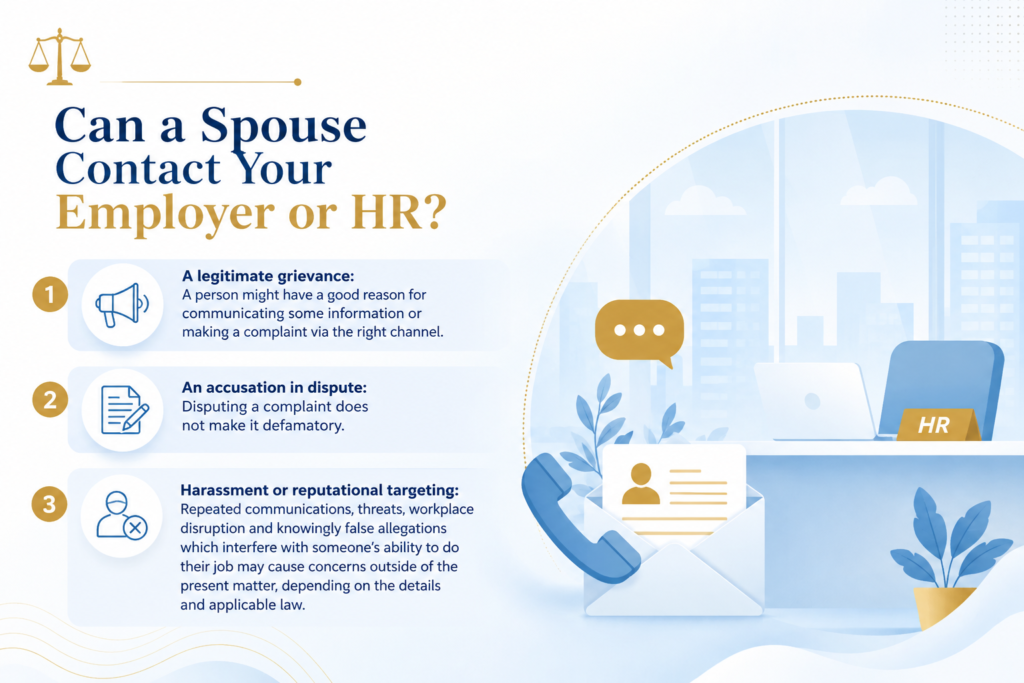
- A legitimate grievance: A person might have a good reason for communicating some information or making a complaint via the right channel.
- An accusation in dispute: Disputing a complaint does not make it defamatory.
- Harassment or reputational targeting: Repeated communications, threats, workplace disruption, and knowingly false allegations that interfere with someone’s ability to do their job may cause concerns outside of the present matter, depending on the details and applicable law.
Why This Matters Beyond One Marriage
The main point is that it is not enough just to keep an estranged spouse away from the office; rather, it is that a marital dispute can lead to the workplace becoming a second field of legal and practical conflict.
- The right to bring a complaint: A spouse can pursue a legitimate legal complaint without necessarily facing any prevention.
- The right to a disruption-free workplace: This does not mean someone has the right to enter another person’s workplace or cause disruptions there.
- The protection of professional reputation: When you communicate with an employer, this action can lead to serious consequences, especially if the allegations made against you are false, malicious, or intended to interfere with your employment.
There’s a line between pursuing a genuine grievance and using someone’s workplace to put pressure on them. A complaint against an employee is not automatically defamatory just because the employee disputes it. At the same time, knowingly false or malicious allegations intended to cause professional harm may raise separate legal issues. The facts and circumstances of the communication will matter.
What This Means If You’re on Either Side of This
If you’re an employee
Don’t just take your spouse’s or their family’s assurance that they will not contact your employer. Track everything and make detailed reports. Be sure to save all emails, letters, messages, and details of each workplace visit. Write to HR or the proper internal body and ask that communications be logged. If the workplace behavior does not cease, contact a lawyer to determine the available options, including if a temporary injunction is justified.
If you’re an employer or HR professional
Employers should not need to decide in a matrimonial dispute. But constant calls, threats, and disruptions can make HR worry. HR should document all communications, avoid treating unsubstantiated claims as established facts, and maintain appropriate confidentiality and data protection practices. Finally, HR should seek legal advice if there is a high risk of a workplace disruption or violation of the law.
What Should You Document?
- Dates and times of visits to the workplace
- Names of people who witnessed incidents
- Emails or letters sent to HR or management
- Messages or calls threatening workplace action
- Any communication that identifies or contacts colleagues
- HR/security reports
- Any documented impact the conduct has had on your employment
Keep the original communications instead of relying only on screenshots or summaries.
Conclusion
A matrimonial dispute does not allow either party to use the other’s workplace as a battleground.
While an employer cannot take a stand on whose side is right in a marriage, it is imperative that they address a complaint made by the estranged spouse. What really matters is what is being said, how it is being said, and whether the conduct is affecting the employee and the workplace.
The Gaurav Gupta order aids in this area. It establishes that a court can issue interim protection when a matrimonial dispute moves to the workplace through frequent visits, disruption, and communications that adversely impact an employee’s professional reputation. It does not mean that each and every communication to the employer will be considered unlawful.
Frequently Asked Questions
Can my spouse legally visit my office during a divorce dispute?
Not automatically. The Gaurav Gupta order shows that a court can restrain an estranged spouse and relatives from entering a particular workplace where the circumstances justify it. The order was fact-specific, however, and does not create a blanket ban on contacting or visiting an employer.
Does a complaint to my HR department automatically count as defamation?
No. Contacting HR does not automatically amount to defamation. Whether a communication is legally actionable depends on what was said, whether it was true or false, the circumstances in which it was made, and its purpose and manner.
Do I have to wait for my divorce case to finish before I can stop this kind of harassment?
Not necessarily. Depending on the circumstances, a person may seek interim relief before the matrimonial proceedings are concluded. Whether an injunction is granted will depend on the facts and applicable legal requirements.
What should I do if my estranged spouse’s family is contacting my employer?
Document every instance. Keep your HR department informed in writing. Speak to a family law advocate about seeking an interim injunction instead of waiting out the dispute.
Can my spouse contact my employer during divorce?
There is no general rule that stops a spouse from contacting an employer. Whether or not such communication leads to legal liability will depend on a number of factors, such as the content, the purpose, the truth of the information, the method used, and the circumstances surrounding it. The Gaurav Gupta ruling shows that courts may get involved when it is claimed that certain workplace behaviours and communications have caused serious disruption or damage to a person’s reputation.
Can I get an injunction before my divorce is over?
Yes, it could be the case. A person need not wait for the marriage proceedings to be finished before applying for interim relief in respect of separate conduct which is alleged to cause harassment, workplace disruption or reputational damage. The decision as to whether an injunction is granted will depend on the facts and the relevant legal requirements.