
Picture this. You’ve just closed a deal. Somewhere in the share purchase agreement sits an indemnity clause the lawyers spent weeks fighting over protection against pre-closing tax liabilities, hidden litigation, regulatory penalties, the works. The buyer feels quiet relief that this protection exists. The seller takes equal comfort in knowing that, sooner or later, it will expire
Then, a few months after closing, a working capital dispute breaks out. Nobody wants to litigate it, so the parties sit down, hash it out, and sign a document that says the matter stands “fully and finally settled.” Everyone shakes hands and moves on.
Eighteen months later, a tax notice for a pre-closing assessment year lands on the target company’s desk.
The buyer reaches for the indemnity clause. The seller reaches for the settlement deed. Now you have a real fight on your hands that proper drafting would have prevented.
So who’s right? There isn’t a clean yes-or-no answer under Indian law. The outcome hinges on five factors: the settlement’s exact wording, the release’s scope, the indemnity clause’s original terms, the timing of the claim, and the signing circumstances. Which is precisely why the drafting of a post-closing settlement deserves nearly as much attention as the original indemnity clause did.
What an Indemnity Actually Is in an Indian M&A Deal
Strip away the jargon, and an indemnity is just a way of allocating risk. The buyer wants the seller on the hook for certain losses that show up after closing usually things like:
- pre-closing tax liabilities
- litigation nobody disclosed
- regulatory penalties
- employee claims
- breaches of specific warranties
- title defects
- environmental liabilities
- or some other risk the parties flagged during diligence
Section 124 of the Indian Contract Act, 1872 defines a contract of indemnity fairly narrowly a promise to make good a loss caused by the promisor’s own conduct or the conduct of a third party. But Indian courts made clear a long time ago that this definition doesn’t tell the whole story. In Gajanan Moreshwar Parelkar v. Moreshwar Madan Mantri, the Bombay High Court held that Sections 124 and 125 don’t exhaust the field, and this is the part deal lawyers actually care about that an indemnity holder doesn’t necessarily have to pay out of pocket first before enforcing the indemnity. Once the liability becomes sufficiently certain, the holder can move.
What that means for drafting is simple, if easy to forget under deal-closing pressure: don’t lean on the statute to do the work your clause should be doing. Spell out, in the SPA itself, what counts as a loss, whose conduct triggers the indemnity, what a “claim” looks like procedurally, and critically how long the protection actually lasts. For a deeper dive into how these clauses are typically structured, see our companion piece on indemnity clauses in Indian M&A.
The Real Danger: A Settlement That Releases More Than Anyone Meant
Here’s where things usually go sideways not at signing, but months later, in an unrelated dispute.
Say the buyer and seller can’t agree on the final purchase-price adjustment. They negotiate it out and sign something along these lines:
“The parties confirm that all claims, demands, disputes, and liabilities arising out of or in connection with the transaction documents stand fully and finally settled.”
Both sides walked into that room to talk about the price adjustment. Neither one was thinking about the tax indemnity. If a dispute erupts later, the seller can easily argue that this language wiped out the indemnity.
This is the doctrine of accord and satisfaction at work, and it’s not a technicality it can genuinely end a right that would otherwise still be alive. The Supreme Court’s ruling in New India Assurance Co. Ltd. v. Genus Power Infrastructure Ltd. is the case most often cited here. The Court found that a voluntarily signed, full-and-final discharge can bring a contractual dispute to a close. It also left the door open on the other side: a discharge signed under fraud, coercion, or undue influence can still be challenged.
That distinction is where the real stakes sit. A buyer shouldn’t assume that resolving one post-closing squabble quietly preserves every other right under the SPA. A seller shouldn’t assume the phrase “full and final settlement” magically erases every future claim, especially if the document carves out exceptions or covers a different dispute.
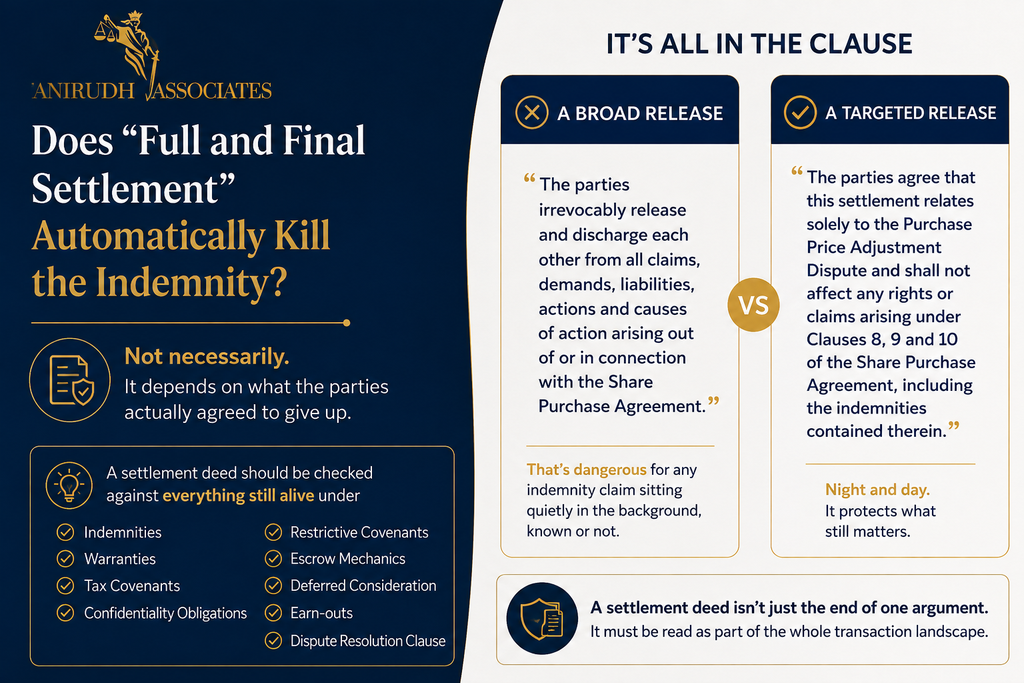
Does “Full and Final Settlement” Automatically Kill the Indemnity?
Not necessarily and this is the part people get wrong most often. The question isn’t whether the words “full and final” appear somewhere in the document. It’s what, specifically, the parties agreed to give up.
Compare these two clauses.
A broad release:
“The parties irrevocably release and discharge each other from all claims, demands, liabilities, actions and causes of action arising out of or in connection with the Share Purchase Agreement.”
That’s dangerous for any indemnity claim sitting quietly in the background, known or not.
A targeted release:
“The parties agree that this settlement relates solely to the Purchase Price Adjustment Dispute and shall not affect any rights or claims arising under Clauses 8, 9 and 10 of the Share Purchase Agreement, including the indemnities contained therein.”
Night and day. The second version tells you exactly what’s being given up and what isn’t.
Which is really the whole point: you shouldn’t view a settlement deed merely as the document that ends a single argument. You must test it against every remaining obligation under the transaction documents, including indemnities, warranties, tax covenants, confidentiality, restrictive covenants, escrow mechanics, deferred consideration, earn-outs, and the dispute-resolution clause itself.
Krish Spinning Changed the Arbitration Question
If the SPA has an arbitration clause, there’s a separate wrinkle worth knowing about.
In July 2024, a three-judge bench of the Supreme Court decided SBI General Insurance Co. Ltd. v. Krish Spinning, and the holding matters well beyond insurance disputes. The Court said that just because one side raises “accord and satisfaction” as a defence doesn’t mean the dispute gets kept out of arbitration. That question can be left to the arbitral tribunal instead of being conclusively decided by the referral court at the Section 11 stage.
For a buyer sitting across the table from a seller waving a settlement deed, that’s genuinely useful it means there’s still likely a route to arbitration, even where a full-and-final settlement exists.
But don’t confuse “we can get to arbitration” with “we’ll win at arbitration.” The settlement deed doesn’t disappear it becomes evidence the tribunal has to weigh. The tribunal will still need to work out whether the settlement was valid, whether it actually covered the indemnity claim, whether the claim had already crystallised, whether the parties meant to preserve future claims, and whether the indemnity survives as a matter of contract. Getting a seat at the table and winning the argument are two different fights.
What Happens to the Contractual Survival Period?
SPAs typically stagger survival periods depending on what’s being protected:
| Protection | Typical treatment |
| General warranties | 12–24 months |
| Tax indemnities | Longer, tied to tax exposure timelines |
| Fundamental warranties | Longer, sometimes uncapped |
| Fraud | Handled separately |
| Specific indemnities | Individually negotiated |
Where this gets tricky is when an SPA says a party is “discharged from all liability” once the clock runs out. Section 28 of the Indian Contract Act specifically clause (b) voids any agreement that extinguishes a party’s rights or discharges liability purely because a specified period has passed, if it restricts the ability to enforce those rights.
The Supreme Court applied this reasoning in Grasim Industries Ltd. v. State of Kerala. That case was actually about a contractual time bar on arbitration, not an M&A indemnity, but the Court’s statement was blunt: a clause that extinguishes rights purely on the expiry of a fixed period is void under Section 28(b).
That doesn’t mean every survival clause in every SPA is unenforceable far from it. But the drafting matters enormously. There’s a real difference between saying:
- The Seller’s liability shall be extinguished after 18 months, and
- The Buyer must notify the Seller of any claim under this indemnity within 18 months, subject to applicable law and the survival provisions of this Agreement.
The first tries to kill the right outright. The second is a notice mechanism a much sturdier thing to build a survival clause around. Whichever way you draft it, do it with Section 28 in mind rather than lifting boilerplate from a foreign-law precedent template and hoping it translates.
Contractual Survival Isn’t the Same as Statutory Limitation
This trips people up constantly, so it’s worth spelling out plainly.
A survival period is something the parties negotiated. Limitation is a statutory clock that Parliament set, and the two don’t necessarily start running at the same time. Article 113 of the Limitation Act, 1963 gives a three-year residuary period, running from when the right to sue accrues, for suits that no other Article covers. For an indemnity dispute, pinning down exactly when that right to sue accrues takes a close look at the specific obligation and the facts it’s rarely as simple as “the day the tax demand arrived.” The Gajanan Moreshwar principle is relevant here too, because it suggests the right to enforce can arise once the liability is sufficiently definite, not necessarily on the date it’s actually paid.
Try this timeline for size:
- 1 January 2025: deal closes.
- 1 January 2027: general indemnity survival period lapses.
- 15 June 2029: a tax authority raises a demand for a pre-closing period.
You can’t answer whether the buyer still has a claim just by saying “well, that’s after the survival period.” A court or tribunal would need to dig into what the indemnity actually covered, whether tax claims had their own longer survival window, whether earlier notice was required and given, whether the contractual period is even enforceable under Section 28, when the cause of action truly accrued, what the settlement deed released (if there was one), and whether the claim is still within the statutory limitation window regardless. Map that clock out before the dispute happens not after, when everyone’s incentives have flipped.
Why Settlement Documents Need an Explicit Indemnity Carve-Out
This is genuinely one of the simplest fixes available, and it’s astonishing how often it’s skipped. If the parties only mean to settle one dispute, say so in the document. If they actually do intend to release the indemnities, say that too plainly, not by implication.
Nobody’s asking for a longer document for its own sake. The point is that the paper should reflect what was actually agreed, so that six months later nobody’s standing in front of a tribunal insisting “we only meant to settle the working capital thing” while the other side points at language that says otherwise.
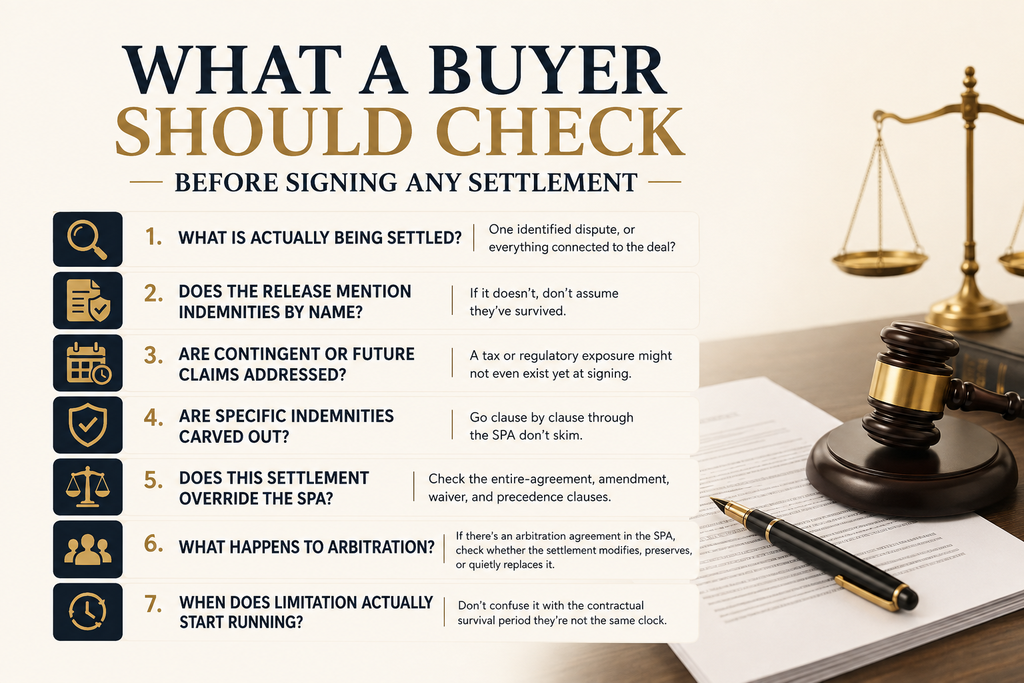
What a Buyer Should Check Before Signing Any Settlement
- What is actually being settled? One identified dispute, or everything connected to the deal?
- Does the release mention indemnities by name? If it doesn’t, don’t assume they’ve survived.
- Are contingent or future claims addressed? A tax or regulatory exposure might not even exist yet at signing.
- Are specific indemnities carved out? Go clause by clause through the SPA don’t skim.
- Does this settlement override the SPA? Check the entire-agreement, amendment, waiver, and precedence clauses.
- What happens to arbitration? If there’s an arbitration agreement in the SPA, check whether the settlement modifies, preserves, or quietly replaces it.
- When does limitation actually start running? Don’t confuse it with the contractual survival period they’re not the same clock.
What a Seller Should Check Before Signing
The seller’s worries run the other way. Before signing, a seller should confirm the settlement genuinely delivers finality, names the claims it’s releasing, blocks the buyer from reopening what’s already been settled, deals with known and contingent liabilities alike, only preserves what’s expressly negotiated to survive, treats indemnity claims separately if that’s the intent, and states clearly which SPA provisions live on.
One thing worth saying plainly: a seller chasing finality shouldn’t rely on the document’s title. Calling something a “Full and Final Settlement Agreement” doesn’t make it one the operative release language in the body is what actually controls.
Four Drafting Habits That Cut Down Indemnity Disputes
- Define “Loss” properly. Don’t leave the commercial scope to Section 124 by default. Spell out whether losses include liabilities, penalties, interest, costs, expenses, third-party claims, and other exposures you’ve actually identified, subject to applicable law.
- Nail down the survival mechanism. State the survival period, the claim-notification process, what happens once notice is given, whether a pending claim survives expiry, and whether specific indemnities run on their own separate clocks.
- Carve indemnities out of settlement documents when that’s the intention. Name the relevant SPA clauses. “All other rights remain unaffected” sounds reassuring but does far less work than people assume.
- Line up the drafting with limitation law. Don’t write a survival clause in isolation read it against Section 28 of the Contract Act and the relevant Limitation Act provisions before you finalise it.
A Worked Example
Say a buyer acquires an Indian company in January 2025. The SPA carries a tax indemnity for pre-closing liabilities. In July 2026, a purchase-price adjustment dispute crops up, and the parties sign a settlement saying: “the parties hereby fully and finally settle all claims arising out of or in connection with the transaction.”
In March 2028, a tax demand for a pre-closing financial year shows up. The buyer invokes the indemnity. The seller points to the 2026 settlement.
Who wins depends almost entirely on the actual wording used in 2026. If that settlement expressly limited itself to the price dispute and preserved the tax indemnity, the buyer is in a considerably stronger spot. If it was an unrestricted release of “all claims,” the seller has a real defence. And crucially, the fact that nobody knew about the tax claim back in 2026 doesn’t settle the question either way the contractual language does the deciding, not the parties’ hindsight.
The Bottom Line
An indemnity clause never really stands alone. Its practical value can be shaped or quietly erased by a later settlement, a release, the precise wording of the SPA, the survival provisions, notice requirements, Section 28 of the Contract Act, the Limitation Act, and whatever dispute-resolution mechanism the parties chose. Krish Spinning is a useful reminder that an accord-and-satisfaction argument doesn’t automatically shut the door to arbitration where a valid arbitration clause exists but it’s not a guarantee of winning once you’re there.
The smarter approach is to stop treating this as a problem for the day the indemnity claim actually lands. Before anyone signs a settlement deed, run it against every obligation still alive under the SPA. And if an indemnity is meant to outlive the settlement, put that in writing, in plain terms a well-drafted carve-out is worth far more than an argument, months later, about what “full and final” was supposed to mean.
Anirudh Associates advises buyers, sellers, founders, and investors on M&A transactions, commercial contracts, indemnity provisions, settlement agreements, and post-closing disputes. If you’re negotiating a share purchase agreement, reviewing an indemnity, or drafting a settlement or release after a deal has closed, get in touch with our corporate team to talk through the contractual and dispute-resolution angles.
Frequently Asked Questions
Does a full and final settlement automatically end an indemnity claim in India?
No. It depends entirely on how the release is worded. A broad release covering “all claims arising out of or in connection with” the transaction documents can wipe out indemnity rights. A targeted release limited to a specific dispute may well leave the indemnity intact.
What is the doctrine of accord and satisfaction under Indian contract law?
It’s the principle that a valid, voluntarily signed settlement can discharge an underlying contractual dispute. In New India Assurance Co. Ltd. v. Genus Power Infrastructure Ltd., the Supreme Court recognised that such a discharge can end a dispute unless it was obtained through fraud, coercion, or undue influence.
Can an indemnity dispute still go to arbitration after a full and final settlement is signed?
Potentially, yes. In SBI General Insurance Co. Ltd. v. Krish Spinning (2024), the Supreme Court held that an accord-and-satisfaction argument doesn’t by itself destroy the arbitration agreement. Whether the settlement actually covers the claim can be left to the arbitral tribunal rather than decided upfront at the referral stage.
What does Section 124 of the Indian Contract Act say about indemnity?
It defines a contract of indemnity as a promise to save the other party from loss caused by the promisor’s own conduct or someone else’s. But as the Bombay High Court noted in Gajanan Moreshwar Parelkar v. Moreshwar Madan Mantri, Sections 124 and 125 don’t cover the field exhaustively.
Does an indemnity holder have to pay the loss before claiming under an indemnity?
Not always. Under the Gajanan Moreshwar principle, an indemnity holder can, in the right circumstances, enforce the indemnity once the liability becomes sufficiently definite without necessarily waiting until the money has actually left their pocket.
Can a contractual survival period in an SPA completely extinguish a party’s liability?
That’s legally shaky if it’s drafted carelessly. Section 28(b) of the Contract Act voids any agreement that extinguishes rights or discharges liability purely on the expiry of a fixed period in a way that restricts enforcement. Survival clauses read much more safely as notice requirements than as automatic extinguishment triggers.
Is a contractual survival period the same as the statutory limitation period?
No, and conflating the two is a common mistake. A survival period is a negotiated allocation of risk; limitation is a statutory restriction on when a proceeding can be brought. Under Article 113 of the Limitation Act, a three-year period generally applies from when the right to sue accrues and that date can differ from whatever the contractual survival window says.
What should a buyer check before signing a full and final settlement in an M&A deal?
What’s actually being settled, whether indemnities are named, whether future or contingent claims are addressed, whether specific indemnities are carved out, how the settlement interacts with the SPA’s entire-agreement and arbitration clauses, and when the applicable limitation period actually begins.